
What Makes a Sportswear Manufacturer Reliable for International Brands?
Sourcing overseas is easy to start and hard to sustain. The manufacturers that keep international brands for years are not the cheapest — they are the most predictable. This guide breaks down the systems, certifications, communication standards and quality controls that separate a reliable sportswear manufacturer from a risky one.
Every international brand has a sourcing story that went wrong. The sample was perfect, the first order was acceptable, and then the second order arrived with the wrong fabric weight, a slightly different colour, and a lead time that slipped by three weeks. Nothing catastrophic happened — but the trust was gone.
Reliability in sportswear manufacturing is not a single trait. It is a combination of systems, communication habits and process discipline that holds up when the order is complicated, the deadline is tight and the buyer is nine time zones away. A manufacturer can have excellent sewing lines and still be unreliable if they cannot confirm a fabric spec in writing, flag a delay before it happens or reproduce a reorder exactly.
This guide is written for brand owners, sourcing managers and product developers who work with — or are evaluating — overseas sportswear manufacturers. It covers the ten traits that define reliability, the certifications worth checking, how to vet a factory before you commit, and the red flags that predict problems before they reach your warehouse.
Quick Answer: What Defines a Reliable Manufacturer?
A reliable sportswear manufacturer for international brands does four things consistently: communicates proactively, documents every specification, controls quality at each stage and delivers on the agreed date. Everything else — certifications, capacity, pricing — supports those four behaviours.
The strongest indicator of reliability is not the factory tour or the price list. It is how the manufacturer behaves during the sampling stage. A supplier who asks precise questions, confirms details in writing and flags potential problems early will usually run a clean bulk order. A supplier who agrees to everything and asks nothing is a warning sign, not a bargain.
Reliability is predictable behaviour, not perfect behaviour. Problems happen in every factory. A reliable manufacturer tells you about the problem before you discover it — and arrives with a solution, not an excuse.
Judge your manufacturer by how they handle the sampling stage and the first reorder. Those two moments reveal more than any certification or factory tour.
What "Reliable" Actually Means in International Sourcing
In domestic sourcing, reliability is mostly about delivery and quality. In international sourcing, it means more. You are working across time zones, languages, currencies and legal systems. A small misunderstanding in a tech pack can become a container of unsellable product. A missed compliance document can hold an entire shipment at customs.
That is why reliability for international brands sits on four foundations:
- Process reliability — the factory has documented systems for sampling, cutting, sewing, finishing and inspection, and follows them every time.
- Communication reliability — information flows clearly in both directions, in writing, with realistic timelines rather than optimistic ones.
- Compliance reliability — the factory can provide the certifications, test reports and documentation that international buyers, retailers and customs authorities require.
- Commercial reliability — pricing, MOQs, payment terms and lead times are stated clearly and honoured.
A manufacturer can be strong in one area and weak in another. The goal is to find one that is solid across all four — or at least transparent about where it is still developing.
The Ten Pillars of a Reliable Sportswear Manufacturer
1. Clear Communication
Responds within a defined window, confirms specs in writing and asks precise questions before production.
2. Certifications & Compliance
Holds social, ethical and quality certifications that international buyers and retailers require.
3. Quality Management System
Documented inspection at cutting, sewing, finishing and pre-shipment — not just a final check.
4. Fabric Consistency
Sources stable fabric lots, retains shade bands and can reproduce the same hand feel on reorder.
5. Sampling Discipline
Provides accurate pre-production samples, revises quickly and treats approval as a formal milestone.
6. Capacity Planning
Gives realistic lead times based on current load — not the shortest possible answer.
7. Order Accuracy
Verifies sizes, names, numbers, labels and packaging piece by piece for roster-based orders.
8. Private Label Support
Handles woven labels, care tags, hangtags and branded packaging as a defined, costed service.
9. Logistics & Documentation
Prepares accurate export documents, packing lists and shipping paperwork without last-minute errors.
10. Financial Clarity
States payment terms, currency, tooling costs and price validity periods clearly and in writing.
Communication: The Most Underrated Reliability Test
If you can only evaluate one thing before placing an order, evaluate communication. Every other reliability trait shows up in it. A manufacturer who communicates well is almost always organised internally. A manufacturer who communicates poorly usually has process problems you have not discovered yet.
Reliable communication in sportswear manufacturing looks like this:
- One named contact who owns your account, rather than a rotating group of unnamed assistants.
- A defined response window — usually 24 hours on business days — stated upfront and honoured.
- Written confirmation of specifications after every discussion. If it is not in writing, it is not agreed.
- Proactive delay warnings before the deadline slips, not after. A manufacturer who tells you on day 20 that the order will be late is not reliable. A manufacturer who tells you on day 5 is.
- Photo and video updates during production, especially for custom decoration, printing and labelling.
- Clear escalation — a named manager you can contact if the account contact does not resolve an issue.
Certifications and Compliance: What International Buyers Should Check
Large retailers and established international brands will not place orders with factories that cannot demonstrate social, ethical and quality compliance. Even if you are a smaller brand, working with a certified factory protects you from supply chain risk, customs delays and reputational damage.
| Certification / Audit | What It Covers | Who Usually Requires It |
|---|---|---|
| WRAP | Social compliance, labour practices, factory conditions | US and EU retailers, mid-to-large brands |
| BSCI (amfori) | Social auditing, worker rights, health and safety | European retailers and brands |
| SEDEX / SMETA | Ethical trade audit covering labour, environment, business ethics | Global retailers and sourcing platforms |
| ISO 9001 | Quality management system documentation and process control | Brands prioritising process consistency |
| OEKO-TEX Standard 100 | Fabric and trim safety — no harmful substances | Brands selling into EU and premium markets |
| GRS (Global Recycled Standard) | Recycled content traceability and chain of custody | Sustainable and eco-positioned brands |
| GOTS | Organic cotton processing and textile supply chain | Organic and natural-fibre product lines |
| REACH / CPSIA | Chemical and safety compliance for EU / US markets | Any brand importing into the EU or US |
Ask for the actual certificate, not a claim. Certificates have issue dates, expiry dates and certification body names. A factory that says "we are compliant" but cannot send a PDF is not compliant — it is hopeful.
Quality Management Systems: Checks at Every Stage
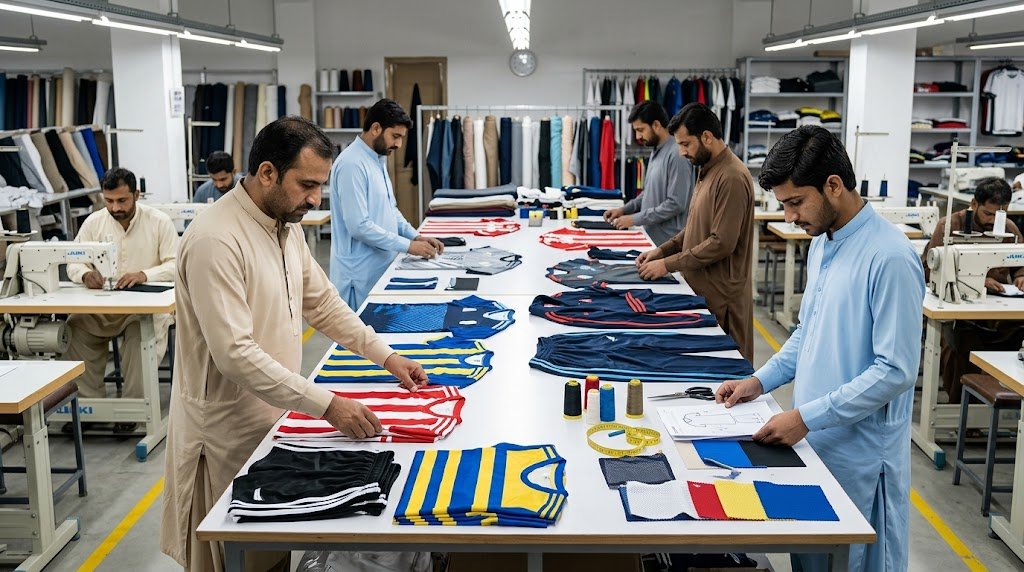
A reliable manufacturer does not rely on a single final inspection. Quality is controlled at every stage, because a defect caught at cutting costs almost nothing to fix, while the same defect caught at packing costs a full garment.
Ask your manufacturer to describe their inspection points. A reliable answer sounds like this:
- Incoming fabric inspection — checking GSM, shade, stretch recovery and defects against the approved standard before cutting begins.
- Cutting inspection — verifying panel dimensions against the pattern and checking for shade variation between panels of the same garment.
- In-line sewing inspection — checking stitch density, seam alignment, underband tension and strap attachment during production, not after.
- Decoration inspection — verifying print placement, embroidery registration, colour accuracy and name/number correctness.
- Finishing inspection — checking thread trims, label placement, measurement points and overall appearance.
- Pre-shipment inspection — a final AQL-based check on a defined sample size before packing and sealing.
Fabric Sourcing and Consistency Across Reorders
One of the most common reliability failures in sportswear is fabric drift. The first order uses a 220 GSM nylon-spandex with a soft hand feel. The reorder arrives at 205 GSM with a slightly firmer finish and a marginally different shade. To the customer, it is a different product.
A reliable manufacturer prevents this in three ways:
- Mill relationships. They work with established mills that can reproduce the same fabric construction from the same specification, rather than buying whatever is available on the open market.
- Shade bands and retention samples. They keep a physical reference of the approved fabric and compare each new lot against it before cutting.
- Written fabric specification. Fibre content, GSM, knit structure, stretch direction, recovery percentage and finish are recorded — not just described verbally.
If you are producing custom performance leggings for activewear brands or custom sports bras for activewear brands, fabric consistency matters even more, because these garments rely on stretch recovery to perform. A fabric that loses recovery after five washes generates returns and reviews that damage the brand.
Sampling and Pre-Production Approval
The sampling stage is the most reliable predictor of bulk production quality. A factory that produces an accurate, well-finished sample — on time, with clear notes — will usually produce a clean bulk order. A factory that produces a rushed, inconsistent sample is telling you something.
What a reliable sampling process looks like
- A confirmed tech pack or specification sheet before sampling begins, not after.
- A realistic sample lead time — usually 7 to 15 working days depending on complexity and fabric availability.
- Photo updates during sampling so you can catch issues before the sample ships.
- A sample that matches the specification — correct GSM, correct colour, correct construction, correct decoration placement.
- Fast, accurate revision if changes are needed. A second round should not take as long as the first.
- Formal written approval before bulk production begins. No verbal go-aheads.
- Retention of the approved sample as the golden reference for bulk and for future reorders.
Capacity, Lead Times and Production Planning
Lead time reliability is one of the clearest signals of a well-managed factory. A manufacturer who gives you a realistic lead time and delivers on it is worth more than one who promises an unrealistically short lead time and then slips.
How to read a lead time estimate
- A realistic answer includes stages — fabric sourcing, sampling, bulk production, decoration, QC, packing and shipping. A single number with no breakdown is a guess.
- A reliable factory mentions their current load. "Our standard lead time is 30 days, but we currently have high season load, so this order would be 40 days" is a trustworthy answer.
- Peak season matters. Sportswear factories are busiest before school terms, sports seasons and holiday periods. If you are ordering in peak season, expect longer lead times and plan accordingly.
- Decoration adds time. Sublimation, embroidery, tackle twill and DTF each add a separate production stage. Complex decoration can add 5 to 10 days to a lead time.
- Roster personalisation adds time. Individual names and numbers are applied piece by piece, and each piece must be verified. This is labour-intensive and should be quoted separately.
Build your own timeline backwards from the delivery date you need, and add a buffer for one unexpected delay. A factory that respects your deadline will appreciate that you planned realistically. A factory that promises to beat any deadline is probably not being honest.
Order Accuracy: Sizes, Names, Numbers and Labels
For brands selling individual products, an order accuracy issue affects one customer. For brands supplying teams, schools and clubs, a single error can affect an entire organisation. A misspelled name on a squad jersey is not a minor defect — it is a public failure the customer will remember.
A reliable manufacturer handles order accuracy with three practices:
- Structured order data. Sizes, names and numbers arrive as a spreadsheet with columns, not as a paragraph in an email or a photo of a handwritten list.
- Per-piece verification. Each garment is checked against the roster sheet before packing. Not by batch — by piece.
- Photographic confirmation. For custom or roster-heavy orders, a photo of the decorated piece before packing gives you a chance to catch an error before it ships.
This applies to printed decoration, embroidered crests and tackle twill letters alike. If your brand produces custom letterman jackets for schools and teams or custom BJJ gis for brands, gyms and teams, per-piece accuracy is even more important because the garment carries a person's name and team identity.
Private Label and Branding Support
A manufacturer who truly supports private label treats branding as a defined part of the production process — with clear costs, clear lead times and clear quality standards. A manufacturer who treats branding as an afterthought will produce garments that arrive with the wrong labels, missing hangtags or inconsistent care instructions.
Reliable private-label support covers:
- Woven neck labels — with your brand name, size and country of origin, stitched at a consistent position and depth.
- Care and content labels — with correct fibre composition, care symbols and compliance language for your target market.
- Size tags — matching your size chart and grading, not the factory's default sizing.
- Hangtags and packaging — branded polybags, tissue, boxes or mailers, specified as line items with their own costs.
- Heat-transfer or printed branding on the underband, sleeve or back neck as an alternative to woven labels.
- Custom packaging for team orders — team-labelled bags, individual player packaging or club-branded boxes.
Logistics, Shipping and Export Documentation
For international brands, the manufacturer's job does not end when the last garment is packed. It ends when the shipment clears customs and arrives at your warehouse. A reliable manufacturer handles export documentation accurately and communicates shipping status proactively.
What to expect from a reliable shipping partner
- Accurate commercial invoice and packing list — with correct HS codes, declared values, quantities and weights.
- Certificate of origin where required for preferential duty treatment.
- Correct carton marking — shipping marks, carton numbers, dimensions and weights matching the packing list.
- Multiple shipping options — air, sea and courier, with realistic transit times and cost comparisons.
- Proactive tracking updates — not waiting for you to ask where the shipment is.
- Support on customs queries — if the shipment is held, the manufacturer should be able to supply additional documentation quickly.
Financial Clarity and Payment Terms
Financial disagreements are one of the most common reasons international brand-manufacturer relationships break down. A reliable manufacturer prevents them by being clear about pricing, payment terms and what is included.
- Quotation with a validity period — fabric prices fluctuate, so a quote should state how long it stands.
- Clear breakdown — unit cost, decoration cost, tooling cost, packaging cost, shipping cost and any third-party inspection fees.
- Defined payment terms — deposit percentage, balance payment trigger, currency and accepted payment methods.
- MOQ stated per design, per colourway or per fabric — not as a single vague number.
- Tooling costs clarified — embroidery digitising, chenille dies, moulds and screen setups are one-time costs and should be listed separately.
- No surprise charges after production — any additional cost should be raised before the work is done, not on the final invoice.
Red Flags: Warning Signs Before You Place a Bulk Order
- Vague answers to specific technical questions — especially about fabric composition, GSM or stretch recovery.
- No certifications available — or only verbal claims without documents.
- Pressure to skip sampling — "we have produced this before, no sample needed."
- Unrealistically short lead times — a promise that beats every other factory by weeks.
- Unwillingness to allow third-party inspection — a serious red flag for any international buyer.
- No written specification after conversations — if it is not in writing, it is not agreed.
- Constant changes of account contact — suggests internal turnover or disorganisation.
- Unclear or changing payment terms — especially requests for full payment upfront without a contract.
How to Vet a Sportswear Manufacturer: A Practical Checklist
Use this checklist before placing a bulk order. If a manufacturer cannot answer most of these questions confidently, that is your answer.
Communication and Process
Who is my named account contact? What is your standard response time? Can you confirm all specifications in writing after every discussion? How do you handle delay notifications? Can you provide photo and video updates during production?
Certifications and Compliance
Which social compliance certifications do you hold (WRAP, BSCI, SEDEX)? Can you provide current certificates? Do you hold OEKO-TEX or equivalent fabric safety certification? Can you supply REACH or CPSIA compliance documentation for the target market?
Quality Management
What are your inspection points in production? What AQL standard do you inspect to? Will you accept a third-party pre-shipment inspection? Can you provide test reports for fabric stretch recovery and opacity?
Fabric and Specification
Can you supply the full fabric specification — fibre content, GSM, knit type, stretch direction, recovery percentage and finish? Do you retain shade bands and approved fabric references for reorders? What mills do you work with for performance knits?
Sampling and Approval
What is your sample lead time? How many revision rounds are included? Do you retain the approved sample as a golden reference? Do you require written approval before bulk production?
Order Accuracy and Packaging
How do you handle roster-based orders with individual names and numbers? Do you verify each piece against the roster sheet? Can you provide a photo of decorated pieces before packing? What private-label options are available and what do they cost?
Logistics and Commercial Terms
How do you prepare export documentation? What shipping methods do you offer and what are the realistic transit times? What are your payment terms? How long is your quotation valid? What is the MOQ per design, per colourway and per fabric?
Practical Examples: How Brands Evaluate Reliability
A European Brand Auditing a New Factory
A mid-sized European activewear brand is evaluating two factories in Pakistan. Both offer similar pricing. The brand sends a detailed tech pack and asks both factories to produce a pre-production sample before any bulk commitment. Factory A responds with five technical questions, proposes a revised fabric GSM based on the intended use, provides WRAP and OEKO-TEX certificates, and delivers the sample in 12 days with photos at each stage. Factory B accepts the tech pack without questions, promises a 7-day sample, and delivers a garment that is close but not accurate. The brand chooses Factory A — not because it was cheaper, but because the process was predictable and documented.
A School Teamwear Supplier Scaling Up
A teamwear brand is moving from 200-piece orders to 2,000-piece seasonal orders. The previous manufacturer handled small orders well but struggled with roster complexity at scale — names were occasionally swapped and numbers were duplicated. The brand moves to a manufacturer who uses structured roster sheets, verifies each piece individually and provides photo confirmation before packing. The per-unit cost is slightly higher, but the elimination of roster errors removes the single biggest source of customer complaints.
A Brand Adding Performance Leggings to Its Range
A running brand already produces custom sports bras and wants to add matching leggings. The key requirement is that both garments use the same fabric blend and the same size block, so customers can buy a set in one size. They choose a manufacturer who can source both products from the same fabric lot and apply the same grading logic — avoiding the most common problem in matching sets, which is a legging that fits differently from the bra at the same labelled size. The detailed guide on manufacturing custom performance leggings for activewear brands covers how that specification process works.
How Habit Fit Sports Supports International Brands
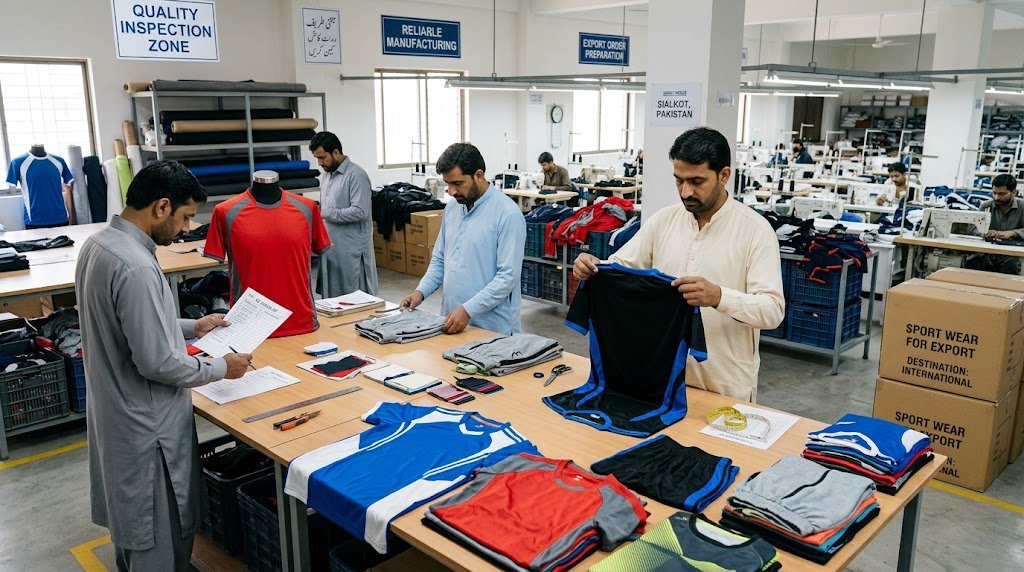
Habit Fit Sports manufactures custom sportswear from Sialkot, Pakistan, for activewear brands, private-label businesses, gyms, schools and teams worldwide. The company's process is built around the same reliability principles covered in this guide: documented specifications, named account contacts, pre-production sampling, in-line quality checks and piece-by-piece verification for roster orders.
Product capabilities include custom sports bras, custom performance leggings and yoga pants, custom letterman jackets for schools and teams and custom BJJ gis for brands, gyms and teams. Brands building a full collection can source multiple product categories from one manufacturer, which keeps fabric, sizing and branding consistent across the range.
On the decoration side, the company provides direct-to-film (DTF) printing for detailed logos and branding, reflective tape manufacturing for visibility and design accents, and 3D embossing for textured fabric finishes.
If you are evaluating manufacturers for an upcoming collection, you can review how the production process works, read the detailed guide on custom sports bras for activewear brands, or contact the Habit Fit Sports team to discuss fabric, sizing, decoration and order requirements. The full range of services is listed on the Habit Fit Sports homepage.
Frequently Asked Questions About Reliable Sportswear Manufacturing
What is the single most important sign of a reliable sportswear manufacturer?
Communication quality during the enquiry and sampling stage. A manufacturer who asks precise technical questions, confirms details in writing and gives realistic timelines will almost always run a clean bulk order. A manufacturer who agrees to everything instantly and promises the shortest possible lead time is usually the least reliable option.
Which certifications should an international buyer check?
At minimum, look for WRAP or BSCI/SEDEX for social compliance, ISO 9001 for quality management, and OEKO-TEX Standard 100 for fabric safety. If you are importing into the EU or US, confirm REACH or CPSIA compliance documentation. Always ask for the actual certificate PDF — not a verbal claim.
Should I allow the manufacturer to skip sampling to save time?
No. The pre-production sample is your only protection against a bulk order that does not match your specification. A manufacturer who suggests skipping sampling is asking you to accept risk without documentation. Always approve a physical sample in writing before bulk production begins.
How do I prevent fabric quality drifting between reorders?
Ask the manufacturer to retain an approved fabric reference or shade band from the first order, and to compare each new fabric lot against it before cutting. Also ensure the full fabric specification — fibre content, GSM, knit type, stretch direction and recovery — is recorded in writing so it can be quoted back to the mill.
What lead time is realistic for a custom sportswear order?
It depends on complexity, quantity and season. A simple sublimated order may take 25 to 35 days after sample approval. Orders with embroidery, tackle twill, roster personalisation or custom packaging typically take longer. Peak season adds further time. Treat any lead time that is significantly shorter than other factories' estimates as a warning sign rather than a bargain.
Will a reliable manufacturer accept third-party inspection?
Yes — a reliable factory welcomes it. Third-party inspection protects both parties by providing an independent record of quality before shipment. A manufacturer who refuses or discourages third-party inspection is a serious red flag for any international buyer.
How should payment terms be structured for international orders?
Typical terms are a deposit of 30 to 50 percent before production begins, with the balance payable before shipment or against shipping documents. All terms should be confirmed in writing, along with the currency, accepted payment methods and the trigger for the balance payment. Avoid paying the full amount upfront without a contract and a clear production timeline.
Why are so many sportswear brands sourcing from Pakistan?
Pakistan, particularly Sialkot, has developed a deep sportswear manufacturing base with established expertise in performance knitwear, sublimation, embroidery and teamwear construction. The combination of technical capability, competitive pricing and willingness to work with mid-sized and emerging brands has made it an increasingly attractive sourcing destination. The wider trend is covered in this article on why Nike and Adidas are quietly moving their manufacturing to Pakistan.
What to Remember About Manufacturer Reliability
Reliability is not about a factory never having problems. It is about how problems are handled, how information is shared and how consistently the process is followed across orders, seasons and reorders. A reliable manufacturer communicates proactively, documents everything in writing, controls quality at every stage and delivers on the date they committed to.
Before you place a bulk order, test the manufacturer's communication, verify their certifications, request a pre-production sample, confirm the AQL standard and ask whether they accept third-party inspection. The answers will tell you more than any price list.
Habit Fit Sports manufactures custom sportswear for international brands, gyms, schools and teams — with a documented process from specification through to shipment. If you are evaluating manufacturing partners, the best next step is to start a conversation about your product and your requirements.
Looking for a Reliable Sportswear Manufacturing Partner?
Whether you are sourcing your first production run or moving a collection to a more dependable factory, Habit Fit Sports can help you build a documented, repeatable manufacturing relationship.
Start a Conversation See How Production WorksHave a specific product or certification requirement? Get in touch to discuss fabric, sizing, decoration and order requirements.