
Custom Letterman Jackets for Schools and Teams: A Complete Manufacturing Guide
A letterman jacket is more than outerwear. It is an award, a uniform and a walking piece of your school or team identity. This guide explains how custom letterman jackets are made — from wool bodies and leather sleeves to chenille patches, sizing, embroidery and private-label production.
If you have ever ordered letterman jackets for a school, a sports team or a graduating class, you probably remember the stress of it. A student measures themselves at home and picks a size from a chart. Six weeks later the jackets arrive, and half of them fit perfectly. The other half are too short in the sleeve, too tight across the shoulders, or the chenille patch sits two inches lower than it did on the approval sample.
For schools and teams, this is more than an inconvenience. A letterman jacket is worn with pride — sometimes for decades. It carries the school crest, the team colours, the student's name and the years of effort that earned it. When the product does not match the standard it represents, everyone notices.
This article is written for the people ordering custom letterman jackets, not the people wearing them. It covers what a varsity jacket is actually made of, how sizing and fit work, what customisation options exist, and what to ask a manufacturer before committing to a production run. It also looks at how schools, teams and brands use custom letterman jackets — and where Habit Fit Sports fits into that process.
Quick Answer: What Makes a Good Custom Letterman Jacket?
A custom letterman jacket is a varsity-style jacket manufactured to your specifications. That means your body fabric, your sleeve material, your rib trim colours, your chenille patches and your embroidery — not a stock jacket with a logo added at the end.
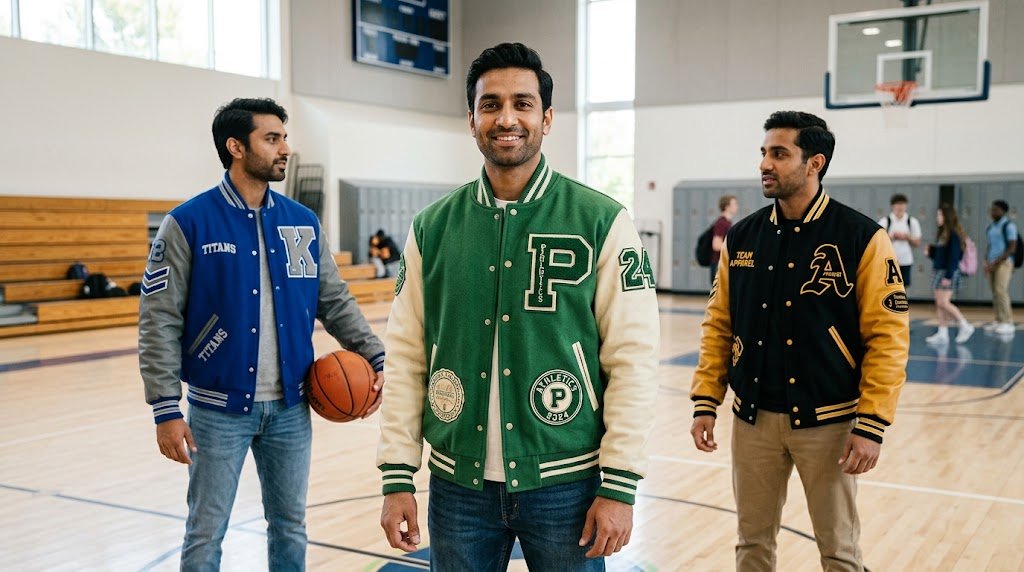
The body is traditionally made from 24oz Melton wool, with cotton-twill or genuine leather sleeves. The collar, cuffs and hem use elastic rib-knit trim, usually striped in school or team colours. Chenille patches are the signature decoration, with embroidery used for names, numerals and finer details. Lining options range from quilted satin to printed satin or mesh.
For buyers, the three decisions that matter most are fabric weight, size grading and patch placement. Get those right, and the jacket will fit well, wear well and look right for years. Get them wrong, and no amount of design work will fix the product.
What Is a Custom Letterman Jacket and Who Needs One?
A letterman jacket, also called a varsity jacket, is a style of outerwear that originated with American college athletics. The jacket was traditionally awarded to students who lettered in a sport, which is where the name comes from. Over time, it became a symbol of achievement and belonging across schools, teams and clubs.
A custom letterman jacket goes further than a standard retail product. Instead of buying a pre-made jacket and adding a patch, the garment is manufactured around your requirements. That can mean a specific wool weight, a particular sleeve material, custom rib trim in your school colours, a chenille patch programme with names and numerals, or a private-label arrangement where the entire jacket carries your brand.
Who typically orders custom letterman jackets?
- High schools and secondary schools awarding jackets to graduating classes or varsity athletes.
- Colleges and universities outfitting sports teams, societies or alumni groups.
- Sports teams and clubs that want matching jackets for competition or travel.
- Brands and private-label businesses building a varsity jacket line for retail or direct-to-consumer sales.
- Corporate and organisation programmes recognising long service or achievement.
- Retailers and distributors looking for a private-label letterman jacket they can sell under their own name.
The requirements differ from buyer to buyer, but the core question is always the same: how do you get a jacket that fits your people, represents your identity, and lasts long enough to matter?
The Main Components of a Letterman Jacket
Body
Traditionally 24oz Melton wool. Dense, firm and warm. Wool blends and fleece are available as lighter alternatives.
Sleeves
Genuine cowhide leather, soft sheep leather or vegan PU leather. Contrasting colours are common.
Rib Trim
Elastic rib-knit collar, cuffs and hem. Often striped in two or three team colours.
Closure
Traditional snap buttons in nickel, brass or custom colours. Zipper closures are available as a modern alternative.
Chenille Patches
The signature decoration. Wool or felt backing with chenille yarn and embroidered outlines.
Lining & Labels
Quilted satin, printed satin or mesh. Woven neck labels, size tags and care labels carry your brand.

Fabric and Material Considerations
The materials you choose determine how the jacket feels, how warm it is, and how long it lasts. Each component — body, sleeves, rib trim and lining — plays a different role.
Body fabric
Melton wool is the classic choice. It is a dense, fully boiled wool that resists wind and holds its shape well. Traditional letterman jackets use 24oz Melton wool, which gives the jacket a substantial, premium feel. Wool blends bring the cost down and can be lighter, while polyester fleece is an option for warmer climates or budget-conscious programmes.
Sleeve material
Sleeves are usually made from leather or a leather alternative. Genuine cowhide is the most durable and develops a natural patina over time. Soft sheep leather feels lighter and more supple. Vegan PU leather is a consistent, animal-free option that is easier to clean and more affordable. Whichever you choose, confirm the colour matching against the body fabric — a black body with sleeves that read slightly grey in daylight is a common disappointment.
Rib trim
The collar, cuffs and hem use elastic rib-knit trim. This is often striped in school or team colours, and the striping needs to match the body and sleeve colours exactly. Rib trim colour matching should be confirmed on the actual knit, not on a Pantone swatch alone. Knit colours can shift slightly depending on the yarn supplier.
Lining
Quilted satin is the traditional lining and gives the jacket a warm, substantial feel. Printed satin allows you to add artwork, a school map or a team slogan inside the jacket. Mesh is a lighter, more breathable option. If you are producing a premium jacket, the lining is a good place to add a detail that customers notice.
Closure
Snap buttons are the traditional closure, usually in nickel, brass or a custom colour. Zipper closures are a modern alternative and can feel more practical for everyday wear. If you choose a zipper, specify a quality brand such as YKK to avoid the zipper failing before the jacket does.

Customisation Options: Chenille Patches, Embroidery and More
Customisation is where a letterman jacket stops being a jacket and starts being an award. The methods below are the ones most commonly used in varsity jacket production.
Chenille patches
Chenille patches are the signature decoration of a letterman jacket. They are made from a felt or wool backing with chenille yarn stitched on top, finished with an embroidered outline. The chenille gives the patch a raised, fuzzy texture that stands out against the wool body.
A typical patch programme includes a front-left logo, a back-centre design and sleeve numerals. The chenille body is usually the school or team's primary colour, with the embroidered outline in a contrasting secondary colour. The outline stitch should be wide enough to define the shape but not so heavy that it overwhelms the chenille.
Embroidery
Embroidery stitches thread directly into the fabric to create a raised design. It is the most durable method for names, numerals and detailed logos. On a letterman jacket, embroidery is commonly used alongside chenille patches — for example, a chenille patch on the chest with an embroidered name on the sleeve.
Leather embossing and debossing
On leather sleeves, embossing or debossing can add a subtle branded detail without adding weight or bulk. This is a premium finishing touch that works well for brands producing a higher-end varsity jacket.
Printed satin lining
A printed lining turns the inside of the jacket into a feature. Schools sometimes print a map, a motto or a graduating class year. Brands use it to reinforce their identity in a way the wearer sees every time they put the jacket on. Direct-to-film (DTF) printing is a useful method for detailed, full-colour designs on lining materials.
Labels and finishing touches
Woven neck labels, size tags and care labels are part of the finished product. If you are building a brand or a school programme, specify these at the same time as the design. They are small details, but they are what makes the jacket feel like a proper product rather than a promotional item.
Fit and Sizing: Getting It Right for Every Student
Letterman jacket sizing is not the same as regular clothing sizing. The standard range runs from XS through to 4XL or beyond, and some manufacturers offer custom sleeve length and body length adjustments for students who fall outside the standard chart.
The challenge for schools and teams is that you are ordering for a wide range of body types, often without in-person fittings. A size chart that works for one group of students may not work for the next. The most reliable approach is to take chest, sleeve and body length measurements and compare them against the manufacturer's actual garment measurements, not just a generic size label.
Before production begins, confirm three things with your manufacturer:
- Who owns the size chart. Are you working from a standard block, or are you supplying measurements for a custom fit?
- How grading works. Grading is the process of scaling a pattern up and down across sizes. Poor grading is why some jackets fit well in size M and badly in size 2XL.
- Whether custom sizing is available. Some manufacturers offer adjusted sleeve or body lengths for an additional cost. This is worth knowing before you collect student measurements.
If you are ordering for a school, it also helps to keep a record of the size chart and the measurements used for each order. That way, reorders in future years can be matched to the same specifications.
Comparison: Which Letterman Jacket Build Suits Which Buyer
The table below is a general starting point. Your manufacturer can help you fine-tune these specifications once you know your audience and climate.
| Factor | Standard School / Team Jacket | Premium Brand Jacket | Best Suited For |
|---|---|---|---|
| Body fabric | Wool blend or Melton wool | 24oz Melton wool | Schools: durability and cost balance. Brands: premium hand-feel and structure. |
| Sleeve material | PU leather or cotton twill | Genuine cowhide or sheep leather | PU for affordability and easy care. Genuine leather for a premium finish. |
| Patch style | Chenille with embroidered outline | Chenille with leather embossing or debossing | Schools: classic chenille. Brands: layered decoration for a premium look. |
| Lining | Quilted satin or mesh | Printed satin | Printed lining for brand storytelling. Quilted satin for warmth. |
| Size range | XS–4XL with custom sizing options | S–2XL with a focused fit | Schools need broader ranges. Brands often prefer a tighter, fashion-focused fit. |
Common Mistakes When Ordering Custom Letterman Jackets
- Choosing fabric based on price alone. A cheaper wool blend may feel fine in a sample but pill or lose its shape after a season of wear.
- Skipping the pre-production sample. A digital mockup tells you nothing about how the jacket hangs, how the chenille patch sits, or whether the rib trim matches the body colour. Always approve a physical sample first.
- Not checking patch placement across sizes. A back patch that looks centred on a size M can sit off-centre on a size 3XL.
- Ignoring colour matching. Wool, leather and rib-knit are different materials. Colours that match on a screen can diverge in production. Confirm colour against physical samples.
- Forgetting labels and packaging. Woven labels, size tags and garment bags are part of the product experience. Specify them upfront.
- Assuming all students fit the standard chart. Collect chest, sleeve and body length measurements where possible, and ask your manufacturer about custom sizing options.
Practical Examples: How Different Buyers Use Custom Letterman Jackets
A High School Awarding Letterman Jackets to Graduating Athletes
A school wants to award letterman jackets to students who have earned varsity letters across multiple sports. The jackets need to carry the school crest in chenille on the chest, the student's name embroidered on the sleeve, and the school colours in the rib trim. The school collects measurements from each student, orders one sample to confirm fit and patch placement, then places the bulk order ahead of the graduation ceremony.
A Sports Team Ordering Matching Jackets for Competition Travel
A competitive sports team wants matching jackets for travel and warm-ups. They choose a wool-blend body with PU leather sleeves in the team's colours, a chenille team logo on the back, and a small embroidered crest on the chest. The priority is consistent colour matching across the whole order and a size range that fits every athlete on the roster. They keep the specification on file so replacement jackets can be ordered in future seasons.
A Private-Label Brand Launching Its First Varsity Jacket Line
A streetwear brand wants to add a varsity jacket to its collection. They are not ordering for a school or team — they need a product that fits their brand aesthetic, with a printed satin lining, leather embossed logo on the sleeve, and woven neck labels. They work with a manufacturer who can advise on wool weight, sleeve material and patch construction, and who can produce a small first run to test the market.
What to Look for in a Letterman Jacket Manufacturer
Design support and tech packs
A tech pack is a document that describes your jacket in production terms: measurements, fabrics, rib trim colours, patch placement, lining, closure type and packaging. If you have one, a good manufacturer should be able to work from it directly. If you do not, ask whether they can help you develop one. This is often the difference between a smooth production run and a series of costly revisions.
Fabric and material selection
Ask what wool weights, sleeve materials and rib trim options are available. A manufacturer who can only offer one combination may not be able to serve your specific market. You want a partner who can explain the trade-offs between a wool blend and 24oz Melton wool, or between PU leather and genuine cowhide, and advise on what suits your audience.
Chenille patch production
Chenille patch production is a specialised process. Ask whether the patches are made in-house or sourced from a third party, and ask to see examples of previous patch work. Look for clean embroidered outlines, consistent chenille coverage and straight, evenly spaced stitching around the patch edge.
Embroidery and decoration
Embroidery on a letterman jacket needs to sit cleanly on heavy wool without puckering the fabric. Ask to see reference photos or physical samples of embroidered names and numerals on similar materials. If your design includes leather embossing or debossing, confirm that the manufacturer has the equipment and experience for it.
Sizing and grading
Confirm whether the manufacturer works from your size chart or their own block, and ask how they grade between sizes. Request a measurement chart for every size in the range before production. For schools and teams, this step prevents the most common complaint of all: an order where half the jackets fit and half do not.
Sampling and quality control
Always request a pre-production sample. The sample lets you check fabric weight, colour matching, fit, patch placement, embroidery quality and stitching. A manufacturer who is reluctant to provide a sample, or who charges disproportionately for one, may not be the right long-term partner.
Production quantities and private label
Minimum order quantities vary between manufacturers and are often calculated per design or per colourway. Clarify this before you plan your order. If you are building a brand, also confirm what private-label options are included — woven neck labels, size tags, care labels and packaging are usually separate line items.
Where Habit Fit Sports Fits Into Your Letterman Jacket Production
Habit Fit Sports works with schools, teams, brands and businesses looking for custom sportswear solutions. The company manufactures custom letterman and varsity jackets in Sialkot, Pakistan, using 24oz Melton wool, genuine leather sleeves and chenille embroidery. The process covers design support, fabric and material selection, patch production, embroidery, sizing, sampling and private-label branding.
For organisations that need more than outerwear, Habit Fit Sports also manufactures custom BJJ gis for brands, gyms and teams and custom rash guards for BJJ and MMA. This means a school, gym or brand can source multiple product types from one supplier instead of managing several separate manufacturing relationships.
On the decoration side, the company provides embroidery services for crests, names and numerals, along with direct-to-film (DTF) printing for lining designs and 3D embossing for leather and fabric detailing. Reflective tape manufacturing is also available for jackets that need a safety or performance element.
If you are planning a letterman jacket order, you can review how the production process works or contact the Habit Fit Sports team to discuss your design files, size requirements and branding needs. You can also see the full range of sportswear manufacturing services on the Habit Fit Sports homepage.
Frequently Asked Questions About Custom Letterman Jackets
What is the difference between a letterman jacket and a varsity jacket?
The terms are generally used interchangeably. "Letterman" comes from the tradition of awarding a jacket to students who earned a varsity letter. "Varsity" refers to the same style of jacket. In manufacturing, both describe the same product: a wool-bodied, leather-sleeved jacket with rib trim and chenille or embroidered decoration.
What is the best body fabric for a custom letterman jacket?
Traditional 24oz Melton wool is the classic choice because it is dense, warm and holds its shape well. Wool blends are a more affordable alternative and can be lighter. Polyester fleece is an option for warmer climates or tighter budgets. The right choice depends on your climate, your audience and your price point.
How do chenille patches work on a letterman jacket?
Chenille patches are made from a felt or wool backing covered with chenille yarn, finished with an embroidered outline. They are stitched onto the jacket rather than heat-applied, which is why they hold up well over time. A typical patch programme includes a front-left logo, a back-centre design and sleeve numerals.
How should I collect sizes for a school or team order?
The most reliable approach is to collect chest, sleeve and body length measurements from each student and compare them against the manufacturer's actual garment measurements. If in-person fittings are not possible, ask your manufacturer for a detailed size chart and consider ordering samples in two or three sizes to confirm the fit before the full order.
Can I add names and numerals to each jacket?
Yes. Embroidery is the most durable method for names and numerals on a letterman jacket. Because each jacket needs different text, this is usually handled as a separate embroidery step. Ask your manufacturer how they manage variable text across an order — some handle it in-house, while others coordinate with a specialist embroiderer.
What is the difference between private label and OEM letterman jacket manufacturing?
In private-label production, the manufacturer uses an existing jacket pattern and you apply your branding, labels and packaging to it. It is usually faster and simpler. In OEM production, the jacket is built to your specifications, which can include a custom pattern, specific wool weight and construction details. OEM gives more control but requires more input from you.
How should I store jacket specifications for future reorders?
Keep a written record of the wool weight, sleeve material, rib trim colours, patch dimensions, embroidery files, size chart and label details. If you reorder a year later, this record lets the manufacturer reproduce the same jacket instead of starting again — and it protects you from the small variations that creep in when specifications are passed on verbally.
What to Remember About Custom Letterman Jackets
A custom letterman jacket is a functional product before it is a symbolic one. The wool weight and sleeve material determine how it feels and how long it lasts. The sizing and grading determine whether it fits your students or athletes. The patch placement and embroidery determine whether it looks right on every wearer. Only after those foundations are correct does the jacket become the award it is meant to be.
Start with the technical decisions, approve a physical sample, and confirm the size chart before you order in volume. Keep a record of every specification so future orders match the first one. That is what separates a programme that works from a one-off order that creates problems.
Habit Fit Sports manufactures custom letterman jackets alongside other sportswear products, giving schools, teams and brands a single source for their apparel needs. If you are developing a jacket programme for your school, team or brand, exploring the manufacturing options is a practical next step.
Ready to Develop Your Custom Letterman Jackets?
Whether you are awarding jackets to a graduating class or launching a private-label varsity line, Habit Fit Sports can help you move from concept to finished product.
Explore Custom Letterman Jacket Manufacturing Contact UsHave a specific specification in mind? Get in touch to discuss your designs, sizes and production requirements.