

A Brand Owner's Guide to Choosing Sportswear Sizes for Global Customers
A "Medium" in the United States is not a "Medium" in Japan. A "Large" in the UK is not a "Large" in Germany. Sizing is the most underestimated source of returns, reviews and lost customers in global sportswear. This guide explains regional size systems, grading, fit blocks, extended sizing and how to build a size chart that works across markets.
Every brand owner eventually learns the same lesson: sizing is not a measurement problem, it is a trust problem. When a customer orders a Medium and receives something that fits like a Small, the product does not get blamed — the brand does. The review says "runs small," the customer does not reorder, and the return costs you the margin on the sale.
When you sell in one country, sizing is manageable. You learn your local fit, you build a size chart, and you refine it over time. When you sell globally, the problem multiplies. A single size chart cannot serve customers in the US, UK, EU, Japan, Korea, Australia and the Middle East without careful thought about regional body proportions, local size conventions and how customers expect sizes to be labelled.
This guide is written for brand owners, product developers and sourcing managers who sell sportswear across borders. It covers how regional size systems differ, why fit blocks matter more than measurements, how grading works, what extended sizing really costs, and how to present size information online so customers order the right size the first time.
Quick Answer: How Should a Global Brand Approach Sizing?
Choose one base fit block for your primary market, then adapt it for other regions rather than building separate patterns from scratch. Publish a body measurement chart (what the customer measures) alongside a garment measurement chart (what the finished product measures). Label sizes according to local expectation in each market.
The three decisions that matter most are: which fit block you build from, how you grade across sizes, and whether you offer extended sizing. Get those right and most customers will order correctly. Get them wrong and no amount of marketing will fix the return rate.
Sizing is not translation. It is construction. A US Large and an EU Large are not the same garment with a different label — they are different fits based on different body proportion data.
Build one strong fit block, grade it carefully, and communicate measurements honestly in every market. Customers forgive a brand that tells the truth about its sizing. They do not forgive one that hides behind vague labels.
Why Sizing Gets Complicated Across Borders
Four factors make global sizing genuinely difficult, and none of them are solved by simply converting numbers.
1. Different size conventions
The US uses numeric sizes for some garments and letter sizes for others. The EU uses a numeric system based on bust or chest circumference in centimetres. The UK uses its own numeric scale that runs differently from both. Japan and Korea often use centimetre-based sizes that map to smaller body proportions. Australia and New Zealand sit between UK and EU conventions.
2. Different body proportions
Even at the same stated measurement, body proportions differ by region. Average height, torso length, shoulder width, hip-to-waist ratio and limb length all vary. A garment designed around North American proportions will fit differently on a customer with East Asian or Northern European proportions — even when the chest measurement matches.
3. Vanity sizing
Over the past three decades, many brands — particularly in the US and UK — have gradually relabelled garments with smaller size numbers than the actual measurements warrant. A modern US size 8 may correspond to measurements that were labelled size 12 in the 1990s. This means "size 8" no longer describes a fixed measurement — it describes a brand's marketing choice.
4. Sportswear-specific fit expectations
Sportswear adds another layer. Compression garments are expected to fit tight. Loose training tops are expected to fit relaxed. Leggings should have negative ease at the waistband but positive ease through the thigh. A single "size chart" cannot communicate all of this — the garment's intended fit has to be stated clearly alongside the measurements.
Regional Size Systems: A Practical Overview
This table gives a broad comparison of how women's tops are labelled across major markets. It is indicative only — actual measurements vary by brand, category and fit block.
| Region | Label Format | Typical Base | Key Consideration |
|---|---|---|---|
| United States | XS–XXL or numeric (0–20+) | Inches, bust/waist/hip | Vanity sizing is widespread; labels run larger than measurements suggest. |
| United Kingdom | 6–24 numeric | Inches, bust/waist/hip | UK numeric sizes run roughly two sizes above US numeric equivalents. |
| European Union | 32–52 numeric | Centimetres, bust circumference | Grading is based on centimetre increments; fit is typically more structured. |
| Japan | S–LL or centimetre-based | Centimetres, height and bust | Smaller overall proportions; height is often a primary sizing factor. |
| South Korea | 44–99 or S–XL | Centimetres, bust and height | Similar to Japan; fit is generally slimmer through the shoulder and torso. |
| Australia / NZ | 6–20 numeric | Centimetres, bust/waist/hip | Similar to UK sizing but with some local variation in grading. |
| Middle East | S–XXL or EU numeric | Centimetres, bust/waist/hip | Often combines EU sizing with more generous length and coverage. |
Body Measurements vs. Garment Measurements
One of the most common sizing mistakes brands make online is publishing only one type of measurement chart. Customers need both.
Body measurement chart
This tells the customer what their body should measure to fit the size. It is the chart a customer uses with a tape measure at home. Typical measurements include bust or chest, waist, hip, and sometimes inseam or height.
Garment measurement chart
This tells the customer what the finished garment measures when laid flat. It is the chart a customer uses to compare against a garment they already own and like. Typical measurements include chest width, body length, sleeve length, and for leggings, waist relaxed, waist stretched and inseam.
The two charts serve different purposes, and both should be published on the product page. A customer who prefers to measure their body will use the first. A customer who prefers to compare against a favourite existing garment will use the second. Providing both dramatically reduces "fits differently than expected" returns.
Measurements Worth Publishing on Every Product Page
Chest / Bust
Measured around the fullest part. Body chart and garment chart should both include this.
Waist
Body waist at the narrowest point; garment waist measured at the waistband.
Hip
Body hip at the fullest point; garment hip measured at the widest point of the garment.
Body Length
Garment measurement from high point of shoulder to hem. Critical for tops and jackets.
Sleeve Length
From shoulder point to sleeve hem. Important for training tops and jackets.
Inseam
For leggings and shorts. Body inseam and garment inseam should both be published.
Waist Relaxed / Stretched
Especially important for leggings, where stretch recovery defines the fit.
Rise
High, mid or low rise. A customer who prefers high-rise will not buy a mid-rise legging.
Fit Blocks: The Foundation of Consistent Sizing
A fit block — sometimes called a base pattern or block — is the master pattern from which all sizes in a style are graded. It defines the proportions of your garment at one reference size, and everything else scales from there.
For a brand selling globally, the fit block is the single most consequential sizing decision. It determines:
- Where the garment sits on the body — high-rise or mid-rise, cropped or full length, fitted or relaxed.
- How the garment moves — shoulder width, armhole depth, torso length, hip curve.
- How the sizes relate to each other — whether the step between Small and Medium is 2 cm, 4 cm or something else.
- Which body types the garment serves well — and which it does not.
Three common approaches to fit blocks
Single Global Fit Block
You build one fit block based on your primary market and sell it everywhere. This is the simplest and cheapest approach, and it works well if your brand has a distinctive fit that customers seek out regardless of region. The risk is that customers in some markets experience the fit as slightly off — too long, too short, too narrow through the shoulder — even if the labelled size is technically correct.
Regional Fit Block Adaptations
You start with a base fit block, then create one or two regional adaptations — typically a "Western" block and an "Asian" block, or a US block and an EU block. The adaptations adjust proportion-critical measurements like body length, sleeve length and shoulder width, while keeping the core construction identical. This is the most common approach for mid-sized global brands.
Fully Separate Regional Blocks
You develop a completely separate fit block for each major market. This gives the best local fit but multiplies your development cost, pattern library and inventory complexity. It is usually reserved for large brands with dedicated regional product teams.
Grading: How Sizes Scale Across the Range
Grading is the process of scaling a pattern up and down across sizes. It is where most sizing problems actually originate — a garment can fit perfectly in Medium and poorly in XL, purely because of how it was graded.
Grading is not simply adding the same number of centimetres to every measurement at every size. Different measurements grow at different rates:
- Chest and bust typically increase by 4–5 cm per size step for women's tops.
- Waist increases by 3–4 cm per step in most grading systems.
- Hip increases by 4–6 cm per step, depending on the fit block.
- Body length increases by 1–2 cm per step — not proportionally with width.
- Sleeve length increases by 0.5–1 cm per step.
- Shoulder width increases by 0.5–1 cm per step.
This is why grading errors show up at the extremes of the size range, not in the middle. If your grading rules are wrong, size Small may fit acceptably while size XL gaps at the neckline, rides up at the waist or pulls across the chest.
Extended Sizing: Inclusive Sizing Done Properly
Extended sizing — sometimes called plus sizing or inclusive sizing — covers sizes beyond the standard XS–XL range. For global brands, this is increasingly expected rather than optional. Customers in every market want to see themselves represented in a size chart.
The critical point: extended sizing is not the same as scaling up a standard pattern. Simply adding centimetres to a size XL to produce a size 3XL creates a garment that fits poorly — too long, too wide at the shoulders, wrong through the armhole and uncomfortable at the waistband.
What proper extended sizing requires
- Separate grading rules for the extended range, because body proportions change at larger sizes.
- Additional pattern work — often a separate fit block for the extended range.
- More sample rounds — at minimum one extra round to test the extended sizes specifically.
- Adjusted construction — wider waistbands, stronger elastics, adjusted strap geometry for sports bras, and different seam placement.
- Honest fit testing — wear testing on real bodies in the extended range, not on a dress form.
Brands that produce custom performance leggings and yoga pants in extended sizes know that the waistband construction and rise often need to change, not just the measurements. The same applies to custom sports bras, where underband tension, strap width and cup construction all need adjustment for larger sizes to provide real support.
Youth and Junior Sizing
If you sell teamwear, school apparel or family-oriented sportswear, youth sizing is a substantial part of your market — and it is not simply a scaled-down version of adult sizing. Children have different body proportions: shorter torsos relative to height, narrower shoulders, different waist-to-hip ratios, and growth patterns that vary widely across the same age.
Youth sizing conventions also differ by region. US youth sizes are typically labelled YS–YXL or by age range. UK and EU youth sizing is often labelled by height in centimetres. Japanese youth sizing sometimes uses height as the primary label, with chest as a secondary reference.
For brands producing custom letterman jackets for schools and teams or custom teamwear collections, youth sizing is often the highest-volume part of the range. It should be developed with its own fit block, not adapted from adult patterns.
Communicating Sizing to Global Customers Online
A great size chart is useless if the customer cannot find it or does not understand it. How you present sizing on the product page directly affects your return rate, your reviews and your repeat purchase rate.
What works on a product page
- Both charts visible without scrolling far — body measurements and garment measurements, side by side or as tabs.
- Measurements in both cm and inches — customers in different markets use different units, and forcing them to convert introduces error.
- Model fit information — "Model is 5'9" / 175 cm, wearing size Medium." This is often more useful to customers than a measurement chart.
- Fit notes for each style — "Runs small, size up if between sizes" or "Relaxed fit, take your usual size."
- Stretch and recovery information — for leggings and compression wear, how much the fabric stretches matters as much as the measurement.
- Size conversion reference — a small conversion table for US, UK, EU and Asia equivalents, so customers can orient themselves.
- Customer reviews with fit feedback — letting customers state their height, weight and size ordered gives real-world fit data.
Reducing Returns Through Better Sizing
In most apparel businesses, sizing-related returns are the single largest category of returns. Reducing them requires action at three points: product development, product page and post-purchase.
At product development
- Fit-test every style in at least three sizes, including the extremes.
- Test extended sizes separately with their own fit block and grading rules.
- Wear-test through actual activity, not just standing measurement.
- Document every approved sample as the reference for future production.
At the product page
- Publish both body and garment measurements.
- Include model height and size worn.
- Add fit notes for each style — runs small, true to size, runs large.
- Provide stretch and recovery information for performance fabrics.
- Link to a conversion chart for international customers.
Post-purchase
- Ask customers why they are returning — collect and analyse the reasons.
- Use review data to identify patterns — if size Small consistently runs small, adjust the grading.
- Update size charts based on real customer feedback, not just internal testing.
- Offer exchanges rather than refunds where possible to retain the customer.
Practical Examples: Three Brand Scenarios
A US Brand Expanding Into the EU
A US running brand sells leggings and sports bras primarily in North America. It wants to expand into Germany, France and the Netherlands. Rather than relabel its US sizes with EU equivalents, the brand develops a regional fit block adaptation — keeping the same construction but adjusting body length, rise and shoulder measurements based on EU body data. It also creates a measurement chart in centimetres and publishes both body and garment measurements. The first EU season produces fewer than half the sizing-related returns the brand originally projected.
A Global Teamwear Brand Serving Schools
A teamwear brand supplies schools in the UK, Australia and the Middle East. It builds a youth sizing block and an adult sizing block separately, and publishes age-based youth sizing (YS–YXL) alongside height-based guidance in centimetres. The brand does not rely on adult patterns scaled down. As a result, schools can order confidently with roster sheets and are not returning garments because "the youth Medium fits like a youth Large."
A Start-Up Launching Extended Sizing
A new activewear brand wants to launch with sizes XS–4XL from day one. Instead of scaling up its standard pattern, it develops a separate extended fit block with different grading rules, wider waistbands, adjusted armholes and a more structured underband on sports bras. The development cost is roughly 40% higher than a standard XS–XL range, but the brand avoids the review pattern that kills new inclusive brands: "sizes run small above XL" and "waistband digs in."
How Habit Fit Sports Handles Global Sizing
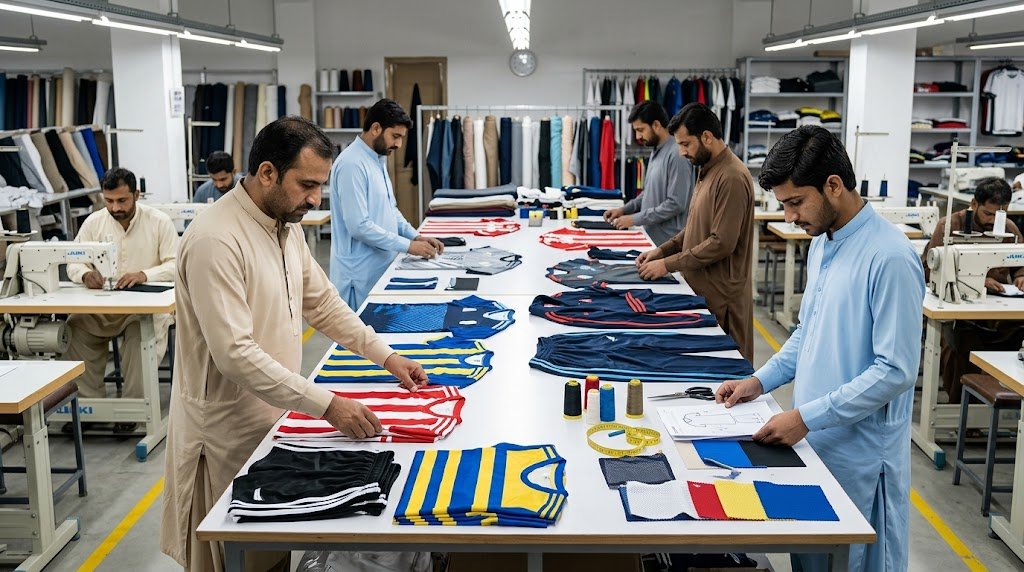
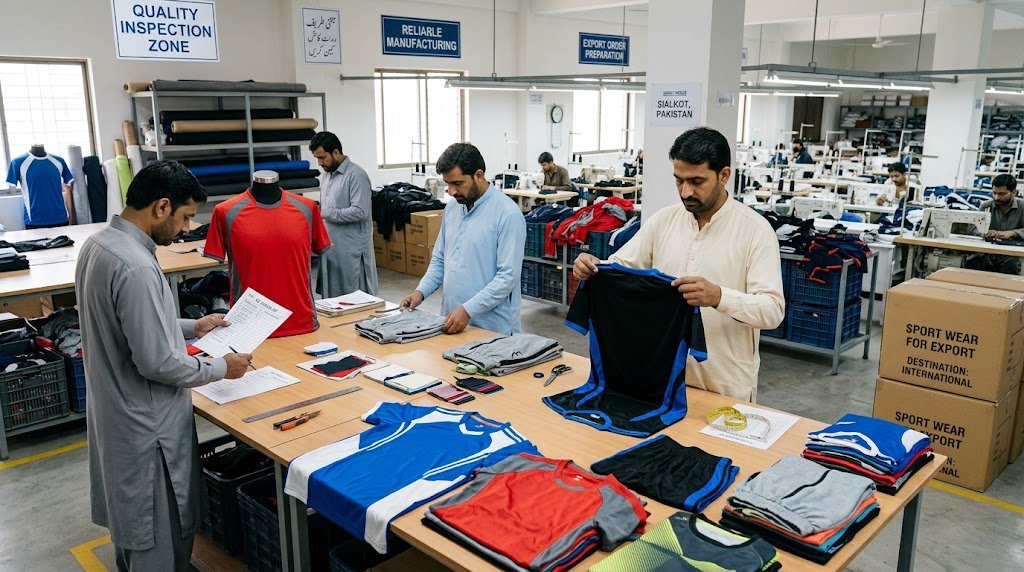
Habit Fit Sports manufactures custom sportswear from Sialkot, Pakistan, for activewear brands, gyms, schools and teams worldwide. Sizing development — fit blocks, grading rules, measurement charts and extended sizing — is part of the standard production process, not an afterthought.
Product capabilities include custom sports bras, custom performance leggings and yoga pants in extended sizes, custom letterman jackets for schools and teams and custom BJJ gis for brands, gyms and teams. Brands building a full collection can develop one consistent size block across multiple product categories, so customers can buy a matching set in a single size.
On the decoration side, the company provides direct-to-film (DTF) printing for detailed logos and branding, reflective tape manufacturing for visibility and design accents, and 3D embossing for textured fabric finishes.
If you are developing a collection for international customers, you can review how the production process works, read the guide on cut-and-sew vs ready-made sportswear, or contact the Habit Fit Sports team to discuss fit blocks, grading, extended sizing and measurement charts. The full range of services is listed on the Habit Fit Sports homepage.
Frequently Asked Questions About Global Sportswear Sizing
How many size charts should a global sportswear brand publish?
At minimum, one body measurement chart and one garment measurement chart per product category. If you sell into multiple regions with meaningfully different fit expectations, you may need separate charts for regional fit adaptations. Publishing measurements in both centimetres and inches is strongly recommended.
Can I just convert US sizes to EU sizes and use the same garment?
No. A conversion chart changes the label, not the garment. A US Large and an EU Large are based on different body proportion data, so the same physical garment will fit differently in each market. If you want a strong fit in both markets, you need a regional fit adaptation — not a relabelled garment.
What is vanity sizing and does it affect my brand?
Vanity sizing is the practice of labelling garments with smaller size numbers than the measurements would traditionally justify. It has become common in the US and UK, particularly in women's apparel. It affects your brand because customers arrive with expectations shaped by other brands — a customer who wears a "Medium" in one brand may be a "Large" in yours, even if your sizing is more standard. Publishing honest measurements is the only reliable solution.
How do I grade across extended sizes correctly?
Extended sizes require different grading rules from the standard range, because body proportions change at larger sizes. In practice, most brands develop a separate fit block for extended sizing, adjust construction details like waistband height and strap width, and fit-test the extended range on real bodies before approving production.
Should youth sizing use the same fit block as adult sizing?
No. Children have different body proportions — shorter torsos relative to height, narrower shoulders, different waist-to-hip ratios. Youth sizing should be developed from its own fit block and graded separately. Scaling down an adult pattern produces a garment that does not fit children properly.
What is the single biggest sizing mistake brands make online?
Publishing only a size conversion table with no measurements. Customers cannot make an informed decision from "US 6 = EU 36" alone. They need body measurements and garment measurements in their preferred unit, plus model fit information. This single change reduces returns more effectively than almost any other adjustment.
How do I test sizing before launching in a new market?
Wear-test your approved sample across at least three sizes in the target market before bulk production. If possible, recruit testers whose body proportions match the target market's typical customer. Collect feedback on fit, comfort and movement. If you cannot recruit local testers, review comparable brands' size charts and reviews in that market to understand local fit expectations.
How often should I update my size charts?
Review your size charts at least once a year, and any time you change a fit block, fabric or manufacturer. Use customer returns data, review feedback and exchange reasons to identify where your sizing is drifting from customer expectations. Update the published charts whenever you update the garment — a chart that no longer matches the product creates more returns than a chart that is honest but imperfect.
What to Remember About Global Sportswear Sizing
Sizing is not a labelling problem. It is a construction problem. The fit block determines how the garment sits on the body. The grading rules determine how it scales across sizes. The construction details — waistband, armhole, strap, rise — determine whether it fits well at the edges of the range. And the size chart determines whether the customer orders the right one.
For global brands, the practical path is clear: build one strong fit block for your primary market, grade it carefully, develop extended and youth sizing with their own rules, and publish honest measurements in both centimetres and inches. Adapt regionally only when sales data shows a specific market needs it — and never rely on a conversion chart as a substitute for fit.
Habit Fit Sports develops custom sportswear sizing alongside the garments themselves, supporting brands with fit blocks, grading, extended sizing and measurement documentation for international customers. If you are launching or expanding a global collection, the best next step is a conversation about your fit and sizing requirements.
Ready to Build Sizing That Works Globally?
Whether you are launching your first collection or expanding into new markets, Habit Fit Sports can help you develop fit blocks, grading rules and size charts that reduce returns and build customer trust.
Discuss Your Sizing Requirements See How Production WorksHave a specific size range or market in mind? Get in touch to discuss fit blocks, grading, extended sizing and measurement charts.