

From Tech Pack to Bulk Order: What Happens Inside a Sportswear Factory?
A tech pack is not a purchase order. It is a set of instructions that has to be interpreted, tested, corrected and executed — by people, machines and systems you will probably never meet. This guide walks through the full factory journey: tech pack review, fabric sourcing, pattern making, grading, sampling rounds, cutting, sewing, decoration, QC, packing and shipping.
Most brand owners see manufacturing as a black box. You send a tech pack, you wait, and eventually a shipment arrives. What happens in between is invisible — and that invisibility is exactly why production problems feel so sudden when they appear.
In reality, the factory process is a sequence of decision points. Each one is an opportunity to catch a problem early — or to let it pass silently into the bulk order. Understanding that sequence changes how you communicate with your manufacturer, how you interpret delays and how you protect your brand.
This guide walks through the full journey inside a sportswear factory, from the moment your tech pack arrives to the moment your cartons are sealed and shipped. It also connects each stage to the error-prevention principles covered in the guide on how clothing brands can reduce production errors before bulk manufacturing.
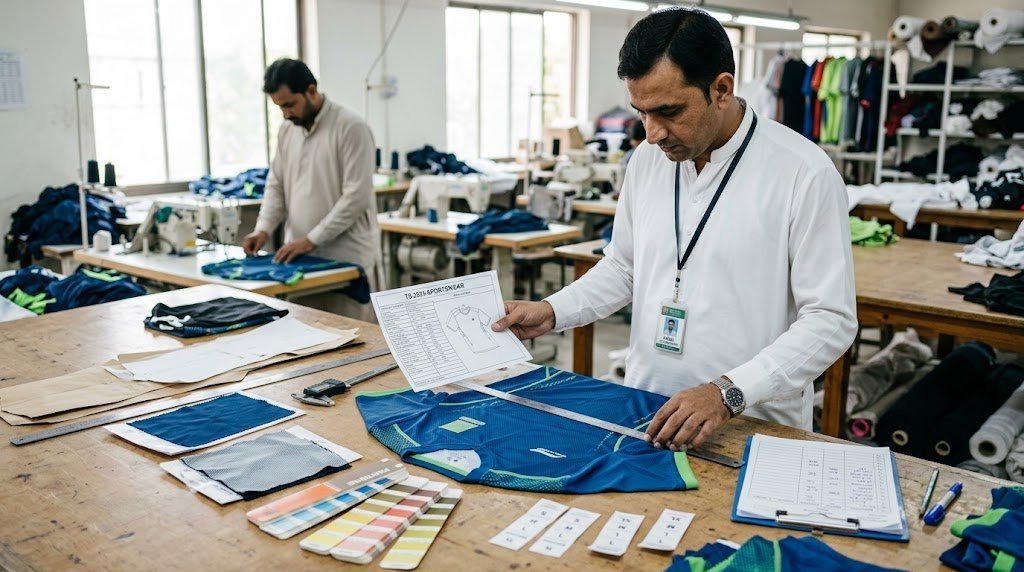
Quick Answer: What Is the Factory Process?
The factory process runs in ten stages: tech pack review, fabric sourcing and approval, pattern making and grading, sampling rounds, pre-production meeting, cutting, sewing and assembly, decoration, quality control, and finishing with packing and shipping.
The stages that most affect your final product are the ones that happen before cutting begins — tech pack review, fabric approval, pattern development and pre-production sampling. Once fabric is cut, the garment's fit, fabric and construction are essentially locked.
A factory does not create your product. It executes your specification. If the specification is unclear, the factory will fill the gap with the most reasonable assumption it can make — and that assumption may not match what was in your head.
The more clearly you define the product before production begins, the less the factory has to guess. That is the entire basis of error prevention in apparel manufacturing.
Stage 1: Tech Pack Review and Clarification
The moment your tech pack arrives, the factory's product development team reviews it. This is not a formality. It is the stage where a good factory asks questions — and where a weak factory stays silent.
What happens during tech pack review
- Technical flats are checked against the construction notes to confirm the garment can be built as drawn.
- Measurements are reviewed to confirm they are internally consistent and can be graded.
- Fabric specification is checked against available fabric qualities or sourcing options.
- Decoration requirements are reviewed to confirm the method suits the fabric and placement.
- Trim and label requirements are noted so sourcing can begin in parallel.
- Questions are raised about anything ambiguous, contradictory or missing.
A factory that sends back five clear technical questions is behaving correctly. A factory that accepts everything without comment is either very experienced with your exact product — or is not reading carefully. The questions a factory asks are one of the clearest indicators of its reliability.
What a Factory Needs Before It Can Start
Technical Flats
Front, back and side views with seams, panels and construction details clearly drawn.
Measurement Chart
Point-by-point measurements with a base size and grading rules stated.
Fabric Specification
Fibre content, GSM, knit type, stretch direction, recovery and finish.
Colour References
Pantone numbers for fabric and trims, with lab dip approval requirements.
Decoration Artwork
Print files, placement dimensions, colour references and decoration method.
Labels & Packaging
Woven labels, care labels, size tags, hangtags and polybag specifications.
Stage 2: Fabric Sourcing and Approval
Fabric is the longest-lead input in most sportswear production, and it is the item most likely to cause delays. This stage runs in parallel with pattern making and sampling, because waiting for fabric to arrive before starting pattern development would waste weeks.
How fabric is selected
- Stock fabric — the factory matches your specification to an existing fabric quality it already holds or can source quickly. Fastest option, lowest MOQ risk, limited to available qualities.
- Development fabric — the factory works with a mill to produce a fabric to your exact specification. Best fit to your needs, higher MOQ, longer lead time.
- Customer-supplied fabric — you provide the fabric. Rare in sportswear because of quality control complexity, but used by some brands with established mill relationships.
Lab dip and bulk approval
For any dyed fabric, the mill produces a lab dip — a small swatch dyed to your reference colour. The lab dip is compared against your Pantone reference and approved in writing. Once approved, bulk dyeing begins. After bulk dyeing, a bulk swatch is sent for final comparison before cutting.
| Approval Stage | What Is Approved | Risk If Skipped |
|---|---|---|
| Fabric quality selection | Composition, GSM, knit structure, stretch, finish | Fabric performs differently than intended in wear |
| Lab dip | Shade against Pantone reference under controlled lighting | Bulk colour does not match brand reference or previous run |
| Bulk fabric swatch | Shade, GSM, hand feel, stretch recovery against approved standard | Entire order cut in a fabric that fails the specification |
| Trim and thread approval | Thread colour, elastic tension, zipper, drawcord, labels | Visually inconsistent finished garment |
Stage 3: Pattern Making and Grading
A pattern is the physical template from which fabric panels are cut. Pattern making is skilled work — it translates the measurements in your tech pack into two-dimensional shapes that, when sewn together, produce a three-dimensional garment that fits the human body.
Base pattern and fit block
The factory either uses an existing fit block (a master pattern it has developed for similar garments) or creates a new one from your measurements. Using an existing block is faster and cheaper. Creating a new block gives you a proprietary fit but requires more sampling rounds.
Grading
Grading is the process of scaling the base pattern up and down across sizes. This is where many sizing problems originate. Grading is not uniform — different measurements grow at different rates. Chest increases by roughly 4–5 cm per size step, waist by 3–4 cm, body length by only 1–2 cm. If the grading rules are wrong, the garment fits in the middle of the range and fails at the extremes.
If you sell globally, grading becomes more complex because regional fit expectations differ. The guide on choosing sportswear sizes for global customers covers how fit blocks and grading need to adapt for different markets.
Stage 4: Sampling Rounds
Sampling is where the tech pack becomes a physical garment for the first time. Most sportswear production involves two or three distinct sample types, each serving a different purpose.
Proto Sample
The first physical sample, usually made in a readily available fabric rather than the final fabric. The proto sample confirms whether the pattern and construction work as intended. It is a fit and construction check, not a final product check. Revisions at this stage are normal and expected.
Fit Sample (or Size Set Sample)
Made in the correct fabric with corrected pattern and construction. The fit sample is where measurements, comfort, movement and fit at multiple sizes are verified. This is the sample that should be wear-tested — not just measured. For performance apparel, wear-testing through the actual activity is essential.
Pre-Production (PP) Sample
The final sample before bulk production, produced with the exact bulk fabric, trims, decoration and packaging. The PP sample is the reference against which bulk production is checked. Once approved in writing, it becomes the golden sample — the standard that settles any dispute during production or on reorder.
Stage 5: Pre-Production Meeting and Approval
Before bulk production begins, a reliable factory holds an internal pre-production meeting. The production manager, cutting supervisor, sewing line supervisor, QC lead and merchandiser review the approved sample, the specification and the production schedule together.
This meeting exists to prevent a specific and common failure: the production floor working from an outdated specification because a change was communicated only to the merchandiser. Written approval of the pre-production sample — circulated to everyone involved — is what prevents this.
What should be confirmed before cutting starts
- Approved pre-production sample, in writing, retained on the production floor as a reference.
- Final approved fabric, trims and thread — physically available and checked against the standard.
- Final measurement chart with grading rules, confirmed and dated.
- Decoration artwork, placement and colour, confirmed and dated.
- Label, tag and packaging specifications confirmed.
- Production schedule, delivery date and shipping method confirmed.
Stage 6: Cutting
Cutting is the point of no return. Once fabric is cut, the garment's fabric, shade and approximate fit are locked. Errors caught before cutting are cheap. Errors caught after cutting affect the entire order.
How cutting works
- Fabric relaxation — fabric is unrolled and allowed to relax before cutting, so it does not shrink after the garment is sewn.
- Spreading — multiple layers of fabric are laid flat in a spread, typically 20 to 100 layers deep.
- Marker placement — the cutting marker (a layout of all pattern pieces) is placed on the spread to maximise fabric usage.
- Cutting — the fabric is cut by straight knife, band knife or automated cutting machine, depending on the factory and the order size.
- Shade separation — panels are checked for shade variation. In a garment made from multiple panels, all panels must come from the same shade band.
- Bundling and numbering — cut panels are bundled by size and numbered so that all panels of a single garment stay together through sewing.
Stage 7: Sewing and Assembly
Sewing is the most labour-intensive stage. In a typical factory, garments move through a production line where each operator performs one or two specific operations — attaching a sleeve, joining a side seam, attaching an underband, hemming a leg opening.
How a sewing line is organised
- Line setup — machines are configured for the specific garment and stitch types required by the tech pack.
- Operator assignment — each operator is assigned to specific operations based on skill and machine type.
- In-line inspection — a QC inspector checks garments during production, not just after, catching issues before they multiply.
- Throughput balancing — the line supervisor balances the workload so no single operation becomes a bottleneck.
- Bundle tracking — bundles move through the line in sequence, with panel numbers keeping each garment's parts together.
This is the stage where construction details in the tech pack — seam type, stitch density, seam allowance, bartacks, topstitching — are actually executed. If the tech pack is vague, the line supervisor will choose the most familiar method, which may not be what you intended.
Stage 8: Decoration and Branding
Decoration happens after the garment is constructed — except for sublimation, which is printed onto fabric before cutting. The decoration stage is where branding turns a manufactured garment into your product.
Common Decoration Methods and When They Happen
Sublimation
Printed onto fabric before cutting. Ink bonds into polyester fibres, so the print stretches with the fabric.
Screen Print
Applied to the finished garment. Best on stable fabrics; water-based inks for stretch garments.
DTF Transfer
Applied to the finished garment with heat press. Handles fine detail and works on a wide range of fabrics.
Embroidery
Stitched onto the finished garment. Needs stable backing; may require a stabiliser behind the fabric.
Tackle Twill
Cut fabric letters sewn onto the garment. Traditional for varsity and letterman jackets.
Heat Transfer Labels
Applied to the finished garment. Common for underband branding and care information.
Decoration placement is one of the most common sources of bulk errors. A print that sits 1 cm too low, an embroidered crest that is slightly off-centre or a name that is positioned inconsistently across garments is immediately visible to the customer. Placement should be specified in the tech pack with measurements from a fixed reference point, not described subjectively.
Stage 9: Quality Control
Quality control in a reliable factory is not a single inspection at the end. It is a series of checkpoints distributed throughout production, so that problems are caught at the stage where they are cheapest to fix.
| QC Checkpoint | What Is Checked | Why It Matters |
|---|---|---|
| Incoming fabric | GSM, shade, stretch, defects, shrinkage | Prevents cutting defective or off-spec fabric |
| After cutting | Panel dimensions, shade consistency between panels | Catches sizing and shade errors before sewing |
| In-line sewing | Stitch density, seam alignment, tension, construction | Catches construction defects before they repeat across the line |
| After decoration | Placement, colour, registration, adhesion or stitch quality | Prevents decorated garments with visible branding errors |
| Finishing | Thread trims, label placement, measurement points, appearance | Catches final presentation issues before packing |
| Pre-shipment (AQL) | Defect rate against AQL 2.5 / 4.0 on a defined sample | Confirms the bulk order meets the agreed quality standard |
Ask your manufacturer which AQL standard they inspect to and whether they accept third-party pre-shipment inspection. A reliable factory welcomes independent inspection — it protects both sides.
Stage 10: Finishing, Packing and Shipping
The final stage turns finished garments into a shippable order. It is also where the brand experience is completed — because what the customer sees when they open the package is decided here.
Finishing
- Thread trimming — all loose threads are removed from seams, hems and decoration areas.
- Pressing — garments are steamed or pressed to remove wrinkles and set the final shape.
- Label attachment — woven labels, size tags and care labels are attached at the specified positions.
- Final measurement check — a sample of finished garments is measured against the approved specification.
- Hangtag attachment — brand hangtags and price tags are attached where specified.
Packing
- Individual polybagging — garments are folded, sized and bagged to your specification.
- Size and colour segregation — packed by size and colourway for easy distribution.
- Roster verification — for teamwear or named orders, each piece is verified against the roster sheet before packing.
- Carton packing — garments are packed into export cartons with the correct quantity and carton marking.
- Packing list — a detailed list of carton contents is prepared for customs and receiving.
Shipping
- Export documentation — commercial invoice, packing list and certificate of origin where required.
- HS code classification — correct codes for customs clearance in the destination country.
- Shipping method — air, sea or courier, depending on urgency, volume and cost.
- Tracking and updates — proactive communication on shipment status, not waiting for the buyer to ask.
A Realistic Timeline: What Happens When
This timeline assumes a mid-complexity sportswear style with a developed fabric and one round of sample revision. Simple styles on stock fabric will be faster. Complex construction, custom fabric or multiple sample rounds will take longer.
Days 1–3: Tech pack review and clarification
The factory reviews the tech pack and sends technical questions. Answers are confirmed in writing.
Days 3–10: Fabric sourcing and lab dip
Fabric quality is confirmed or developed. Lab dip is produced and submitted for approval.
Days 5–12: Pattern making and grading
Pattern is developed or adapted from an existing block. Grading rules are applied across the size range.
Days 12–22: Proto sample
First sample is produced. Fit and construction issues are identified. Revisions are agreed.
Days 22–35: Fit sample and wear testing
Sample is made in final fabric and tested in multiple sizes. Fit feedback is provided and pattern is revised if needed.
Days 35–45: Pre-production sample and approval
Final sample is produced with bulk fabric, trims and decoration. Approved in writing and retained as the golden sample.
Days 45–50: Pre-production meeting and fabric in-house
Production team reviews the approved sample and specification. Bulk fabric is inspected and released for cutting.
Days 50–58: Cutting
Fabric is spread, cut, checked for shade and bundled by size.
Days 58–75: Sewing and assembly
Garments are constructed on the sewing line with in-line QC checks.
Days 70–80: Decoration
Printing, embroidery or transfers are applied. Placement and colour are verified.
Days 80–88: Finishing, QC and packing
Trimming, pressing, labelling, final inspection and packing.
Days 88–95: Shipping
Export documentation is prepared. Goods are shipped by the agreed method.
Total elapsed time from tech pack to shipment for a mid-complexity style is typically 8 to 14 weeks. Peak season, complex construction, custom fabric and multiple sample rounds all extend this. Build your timeline backwards from your delivery date, and add a buffer for at least one delay.
What Slows a Factory Down (and How to Avoid It)
- Slow sample feedback. Every day you take to review a sample is a day added to the timeline. Review samples the day they arrive.
- Vague revision comments. "Make it tighter" is not a revision instruction. "Reduce chest width by 2 cm at the underarm point" is.
- Specification changes after sampling. A change made after sample approval requires a new sample round. If it must change, expect the delay.
- Fabric delays. Custom fabric takes longer than stock fabric. If your launch date is tight, use stock fabric for the first run.
- Unapproved artwork or labels. Decoration files and label artwork must be final before cutting begins. Late artwork delays finishing.
- Changes during peak season. Factories run at capacity in the months before school terms and sports seasons. Plan around it, or expect longer lead times.
- Roster data arriving late. For teamwear and named orders, names and numbers must be final before decoration begins.
- Payment delays. Production may pause if deposits are not received on schedule. Confirm payment terms upfront and pay on time.
Practical Examples: Two Orders, Two Journeys
A Performance Legging Order With Clear Specifications
A brand sends a complete tech pack for a high-rise performance legging: 240 GSM nylon-spandex, four-way stretch, flatlock seams, specific waistband height, custom woven label and DTF logo on the left hip. The factory asks three clarifying questions about waistband construction and decoration placement. Lab dip is approved in two days. The proto sample reveals a minor issue with the waistband tension, which is corrected in the fit sample. The PP sample is approved in writing. Bulk production runs on schedule and ships in 11 weeks. No specification questions arose during bulk production, because none were left unanswered.
A Jersey Order That Hit Every Delay
A teamwear brand sends a partially completed tech pack — measurements are provided, but fabric GSM is not specified and decoration placement is described as "centred on the chest." The factory assumes a 160 GSM polyester based on the style. The proto sample arrives; the brand decides the fabric is too light and requests 180 GSM instead. This requires a new fabric order, a new lab dip and a new sample round — six weeks of delay. Decoration placement is clarified only after the fit sample, adding another revision. The order ships 15 weeks after the original tech pack was sent, missing the start of the season.
How Habit Fit Sports Runs the Factory Process
Habit Fit Sports manufactures custom sportswear from Sialkot, Pakistan, for activewear brands, private-label businesses, gyms, schools and teams worldwide. The production process follows the same ten-stage sequence described in this guide — tech pack review, fabric sourcing and approval, pattern making and grading, sampling, pre-production approval, cutting, sewing, decoration, QC and shipping.
Product capabilities include custom sports bras, custom performance leggings and yoga pants, custom letterman jackets for schools and teams and custom BJJ gis for brands, gyms and teams. Brands building a full collection can source multiple product categories from one manufacturer, which keeps fabric, sizing and specifications consistent across the range.
On the decoration side, the company provides direct-to-film (DTF) printing for detailed logos and branding, reflective tape manufacturing for visibility and design accents, and 3D embossing for textured fabric finishes.
If you are preparing a bulk order, you can review how the production process works, read the guide on cut-and-sew vs ready-made sportswear, or contact the Habit Fit Sports team to discuss your tech pack, sampling requirements and production schedule. The full range of services is listed on the Habit Fit Sports homepage.
Frequently Asked Questions About the Factory Process
How long does it take from tech pack to bulk shipment?
For a mid-complexity sportswear style with a developed fabric and one sample revision, typically 8 to 14 weeks. Simple styles on stock fabric can be faster. Custom fabric development, complex construction, multiple sample rounds and peak season all extend the timeline. Build your schedule backwards from your delivery date and add a buffer.
What is the difference between a proto sample, a fit sample and a PP sample?
A proto sample is the first physical sample, usually in a substitute fabric, used to check pattern and construction. A fit sample is made in the final fabric and used to verify measurements, comfort and fit across sizes. A pre-production (PP) sample is made with the exact bulk fabric, trims, decoration and packaging, and becomes the golden sample once approved.
Why is fabric approval so important before cutting?
Once fabric is cut, it cannot be changed. If the bulk fabric differs from the approved standard in shade, GSM, hand feel or stretch recovery, the entire order is affected. Approving the lab dip and the bulk fabric swatch before cutting is the last opportunity to catch a fabric problem before it becomes an expensive defect.
What is a golden sample and why does it matter?
A golden sample is the signed-off pre-production sample retained as the reference for bulk production and all future reorders. If a dispute arises during production or on reorder, the golden sample settles it. Without one, specifications drift, colours shift and consistency is lost.
What QC checkpoints should happen inside the factory?
A reliable factory inspects at incoming fabric, after cutting, during sewing (in-line), after decoration, at finishing and before shipment. The pre-shipment inspection should follow an AQL standard — commonly AQL 2.5 for major defects and AQL 4.0 for minor defects.
Why do some orders take much longer than expected?
The most common causes are slow sample feedback from the brand, vague revision instructions, specification changes after sampling, custom fabric delays, unapproved artwork or labels, and peak season capacity. Most delays are caused by decisions that were not finalised early enough — not by the factory working slowly.
Can I visit the factory or get photos during production?
Many manufacturers welcome factory visits, and most will provide photo or video updates during sampling and production. This is especially useful for decoration, labelling and packing stages. If a manufacturer is unwilling to provide production updates or allow inspection, that is a reliability red flag.
What should I do if I find a problem in the bulk order?
Raise it immediately with the manufacturer, provide photographic evidence and reference the approved golden sample and specification. A reliable manufacturer will investigate, identify whether it is an isolated issue or a batch issue, and propose a resolution. For significant defects, third-party inspection reports provide an independent record.
What to Remember About the Factory Process
A sportswear factory is not a black box. It is a sequence of stages, each of which depends on the one before it. The tech pack determines the pattern. The pattern determines the sample. The sample determines the bulk. And the bulk determines what your customer receives.
The stages that matter most are the ones that happen before cutting: tech pack review, fabric approval, pattern and grading development, and pre-production sampling. Once fabric is cut, your options for change disappear. Everything before that point is a chance to correct course cheaply.
Habit Fit Sports runs this full process for brands, gyms, schools and teams — from tech pack review through to pre-shipment inspection and export documentation. If you are preparing a bulk order and want a clear, documented path from specification to shipment, the best next step is a conversation about your product and your timeline.
Ready to Start Your Next Bulk Order?
Whether you are placing your first production run or moving a collection to a more reliable factory, Habit Fit Sports can guide you through the full process — from tech pack to finished, packed and shipped product.
Start Your Production Project See How Production WorksHave a specific product, fabric or deadline in mind? Get in touch to discuss tech packs, sampling, decoration and lead times.