

Rash Guards for BJJ and MMA: How to Choose the Right Custom Rash Guard for Your Brand
You have a clear idea for your brand’s next product: a rash guard that performs under pressure and looks sharp on the mat. But between fabric choices, printing methods, and manufacturing details, the path from concept to finished product is not always obvious. This guide breaks down what matters when developing a custom rash guard for BJJ and MMA.
If you run a BJJ academy, own a fightwear brand, or manage an MMA gym, you have probably seen the same problem play out more than once. A member or customer buys a rash guard from a generic supplier. It looks fine for a few weeks. Then the stitching starts to pull, the print fades, or the fit never quite worked in the first place. The product does not hold up to the demands of grappling, and the person wearing it ends up frustrated.
For brands and businesses, this is more than a minor inconvenience. A rash guard that fails on the mat reflects on your name. It also wastes the time and money you invested in sourcing it. The alternative is to manufacture a custom rash guard that is built around your specifications, your brand, and the actual needs of the people who will wear it.
This article explains what a custom rash guard for BJJ and MMA actually involves. It covers fabric options, printing methods, fit considerations, and the manufacturing questions you should ask before placing an order. It also looks at how brands, gyms, and teams can use custom rash guards commercially — and where Habit Fit Sports fits into that process.
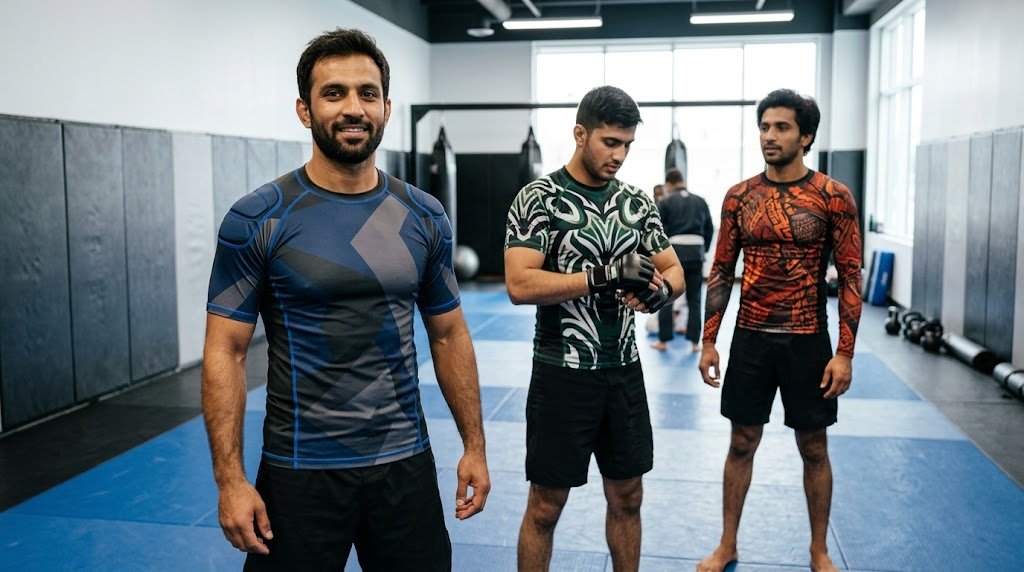
Quick Answer: What Makes a Good Custom Rash Guard?
A custom rash guard for BJJ and MMA should be built from a polyester-spandex or nylon-spandex blend that offers four-way stretch and moisture-wicking properties. Flatlock stitching is essential because it creates a smooth seam that will not rub against the skin during grappling. Sublimation printing is the most common decoration method for full-color designs because the ink becomes part of the fabric rather than sitting on top of it.
The right fit is snug but not restrictive. It should stay in place during movement without cutting off circulation or limiting range of motion. For brands, the key is to work with a manufacturer that can match these technical requirements while also delivering your logo, colorway, and branding in a way that looks professional and holds up over time.
What Is a Rash Guard and Why Does It Matter for Grappling?
A rash guard is an athletic shirt made from synthetic fabrics, usually a blend of spandex with polyester or nylon. It was originally developed for surfers to prevent skin irritation from waxed surfboards and saltwater. Over time, it became standard equipment in grappling sports because it solves a specific problem: direct skin contact with mats, opponents, and equipment.
In BJJ and MMA, a rash guard serves three practical functions. First, it protects the skin from abrasions and from bacteria that can live on training mats. Second, it wicks sweat away from the body, which helps regulate temperature and keeps the fabric from becoming heavy and uncomfortable. Third, it provides light compression that supports muscles and reduces fatigue during long training sessions.
For a brand or gym, the functional purpose of a rash guard is the foundation. If the product does not perform these basic tasks well, no amount of branding or design will make it a good product. That is why understanding the technical side of rash guard manufacturing matters before you start thinking about logos and colorways.
BJJ Rash Guards vs. MMA Rash Guards: What Is the Difference?
At first glance, a rash guard for BJJ and a rash guard for MMA look almost identical. Both are form-fitting, made from stretch fabric, and designed to be worn during training. But there are practical differences that affect how the product should be made.
In BJJ, rash guards are often worn under a gi or as the primary training top in no-gi classes. IBJJF competition rules sometimes require rash guards to match belt colors, which means brands and gyms need to offer multiple colorways within the same product line. The fabric also needs to withstand the friction of gi grips and constant contact with the mat.
MMA rash guards are typically worn as a base layer under shorts during sparring and training. They are often shorter in the torso and sometimes have a looser fit around the shoulders to allow for striking movement. The priority is freedom of movement and moisture management rather than the compression-focused fit common in BJJ.
For manufacturers, this means that a single rash guard pattern does not serve both markets equally well. A brand targeting BJJ athletes and a brand targeting MMA fighters may need slightly different specifications even if the product category is the same.
Fabric and Material Considerations
The fabric is the single most important factor in how a rash guard performs. Most quality rash guards use a blend of polyester and spandex, or nylon and spandex. The spandex provides the stretch, while the polyester or nylon provides durability and moisture-wicking properties.
Fabric weight is measured in grams per square meter, usually shortened to GSM. A lighter fabric, around 180 to 200 GSM, feels cooler and is often preferred for training in warm climates. A heavier fabric, around 220 to 260 GSM, offers more durability and a more substantial feel. Neither is inherently better — the right choice depends on the target market and the intended use.
One detail that matters more than many people realize is the type of stretch. Four-way stretch means the fabric stretches in both directions, which allows the garment to move with the body during grappling. Two-way stretch only stretches in one direction and can feel restrictive. For BJJ and MMA, four-way stretch is the standard expectation.

Printing and Decoration Methods for Custom Rash Guards
How your design is applied to the fabric affects both the look and the longevity of the product. There are two main methods used in rash guard manufacturing: sublimation printing and screen printing. Each has strengths and limitations.
Sublimation Printing
Sublimation is the most common method for full-color rash guard designs. The ink is printed onto transfer paper and then heated until it turns into gas, which bonds with the polyester fibers in the fabric. The result is a print that does not crack, peel, or fade because the color is part of the material itself. Sublimation works best on light-colored or white polyester fabrics, which is why most sublimated rash guards have a white or light base.
Screen Printing
Screen printing applies ink directly onto the surface of the fabric through a mesh screen. It is a good option for solid-color logos and simpler designs, especially on darker fabrics where sublimation is less effective. Screen printing can produce a thicker, more textured print, but it may crack over time if the ink is not properly cured or if the fabric stretches too much. For rash guards, screen printing is often used for small logos or branding elements rather than full-front designs.
Fit and Sizing: Getting It Right for Grappling
Fit is where many custom rash guards fall short. A rash guard that is too loose will bunch up during rolling and create uncomfortable folds. One that is too tight can restrict breathing and movement, especially around the shoulders and chest.
The goal is a snug, second-skin fit that stays in place without feeling restrictive. Sleeve length matters as well. Long-sleeve rash guards offer more skin protection and are common in BJJ, while short-sleeve versions are often preferred for MMA and warmer training environments.
For brands and gyms ordering in bulk, sizing consistency is critical. If a customer orders a medium from one production run and a medium from the next, the fit should be the same. This is something to confirm with your manufacturer before production begins. Ask how they handle size grading and whether they work from a size chart you provide or one of their own.
Common Mistakes When Ordering Custom Rash Guards
Even experienced buyers make mistakes when sourcing custom rash guards. Here are the most common ones and how to avoid them.
- Choosing fabric based on price alone. A lower-cost fabric may save money upfront but can wear out faster, which hurts your brand’s reputation in the long run. Balance cost with performance.
- Skipping the sample stage. Approving a digital mockup is not the same as approving a physical sample. Always request a pre-production sample to check fit, print quality, and stitching before bulk production.
- Ignoring stitching details. Flatlock stitching is not a decorative choice. It is a functional requirement for grappling apparel. If a manufacturer does not offer flatlock, the product may not be suitable for BJJ or MMA.
- Assuming one size chart fits all. If you are selling to both men and women, or to different age groups, you need separate patterns and size charts. A unisex rash guard relabeled as a women’s product rarely fits well.
- Not clarifying branding details. Woven labels, care tags, and packaging are part of the finished product. If these are not specified upfront, they may be overlooked or added at extra cost later.
Practical Examples: How Different Buyers Use Custom Rash Guards
The needs of a small startup brand are different from those of an established gym or a school sports program. Here are three realistic scenarios.
A Small Fightwear Brand Launching Its First Collection
A two-person team wants to launch a no-gi apparel brand. They have designs ready but no manufacturing experience. They need a supplier who can guide them on fabric selection, suggest a suitable GSM for their climate, and produce a small first run to test the market. They prioritize low minimum order quantities and a manufacturer who can handle both sublimation printing and woven label application.
A BJJ Academy Ordering Team Rash Guards for Competition
An academy wants matching rash guards for its competition team. They need consistent sizing across a range of body types, durable fabric that can handle frequent training, and a design that includes the academy logo and belt-color accents. They order a sample first, confirm the fit, and then place a bulk order before competition season.
An MMA Gym Adding Branded Apparel to Its Retail Section
A gym wants to sell branded rash guards to its members. They are not building a standalone brand — they want apparel that looks professional and carries the gym’s identity. They choose a private-label arrangement where the manufacturer uses an existing rash guard pattern and applies the gym’s logo and colors. This keeps costs predictable and speeds up production.
Comparison: Fabric Weight and Print Method by Use Case
The table below gives a practical starting point for matching fabric and printing choices to common buyer scenarios. These are general guidelines — your manufacturer can help you fine-tune the specifications for your specific product.
| Factor | Training Rash Guard | Competition Rash Guard | Best Suited For |
|---|---|---|---|
| Fabric weight | 180–200 GSM | 220–260 GSM | Training: warm climates and frequent use. Competition: durability and a more substantial feel. |
| Print method | Sublimation or screen print | Full sublimation | Sublimation for full-color designs. Screen print for single-color logos on darker fabrics. |
| Stitching | Flatlock | Flatlock with reinforced stress points | Any grappling use. Flatlock prevents seam irritation and holds up under friction. |
| Sleeve length | Short or long | Long | Long sleeves for more skin protection and IBJJF compliance in some divisions. |
The SERP never lies. Before you decide on fabric, printing, or fit, look at what already ranks for your target keyword. If the top results are comparison articles and product pages, the searcher is in a buying mindset. If they are tutorials and guides, the searcher is still learning. Your product and content must match that intent.
What to Look for in a Rash Guard Manufacturer
Working with the right manufacturer makes the difference between a product that sells and one that sits in inventory. Here are the factors to consider when evaluating a potential supplier for custom rash guards.
Design and Pattern Development
A good manufacturer should be able to work from your design files or tech pack. If you do not have a tech pack, they should be able to help you develop one. This includes pattern creation, size grading, and confirming how your artwork will be placed on the garment panels.
Fabric Selection
Ask what fabric options are available and how they perform. A manufacturer who only offers one type of fabric may not be able to serve your specific market. Look for suppliers who can advise on GSM, stretch type, and the difference between polyester-spandex and nylon-spandex blends.
Printing Capabilities
Confirm whether the manufacturer handles sublimation, screen printing, or both. If your design requires full-color sublimation, make sure the factory has the equipment and experience to produce a clean, accurate print. Ask to see sample prints or reference photos of previous work.
Stitching and Construction
Flatlock stitching is the standard for grappling apparel. It creates a flat, low-profile seam that reduces friction against the skin. Ask whether flatlock is used throughout the garment and whether stress points — such as the shoulders and side seams — are reinforced.
Sampling and Quality Control
Always request a pre-production sample before committing to a bulk order. The sample lets you check fabric feel, fit, print quality, and stitching. A manufacturer who is reluctant to provide a sample or who charges excessively for it may not be the right partner for a long-term relationship.
Private Label and Branding
If you are building a brand, you need a manufacturer who can apply your woven labels, care tags, and packaging. This is often called private-label or OEM production. Confirm what branding elements are included and whether there are additional costs for tag printing or custom packaging.
Where Habit Fit Sports Fits into Your Rash Guard Manufacturing
Habit Fit Sports works with brands, teams, gyms, and businesses looking for custom sportswear solutions. The company manufactures custom and private-label sportswear, including custom rash guards for BJJ and MMA. The manufacturing process covers design support, fabric selection, sublimation printing, flatlock construction, and private-label branding.
For buyers who need more than a single product category, Habit Fit Sports also offers screen printing services and sublimation printing services that can be applied across different garment types. This is useful for gyms and teams that want a consistent look across rash guards, training tops, and other apparel.
If you are exploring manufacturing options and want to discuss your specific requirements, you can reach out to the Habit Fit Sports team. The company can review your design files, recommend suitable fabric and printing methods, and explain the production process from sampling through delivery. You can also learn more about how the production process works before placing an order.
For brands that also need other sportswear products, Habit Fit Sports manufactures a broader range of apparel. That means you can source multiple product types from one supplier rather than managing several separate manufacturing relationships.
Frequently Asked Questions About Custom Rash Guards
What is the best fabric for a BJJ or MMA rash guard?
The most common and reliable choice is a polyester-spandex blend with four-way stretch. Nylon-spandex is also used and tends to feel slightly softer, though it can be more expensive. The ideal fabric weight depends on whether the rash guard is for daily training or competition, but a range of 180–260 GSM covers most use cases.
Can I put my brand logo on a custom rash guard?
Yes. Most manufacturers offer sublimation printing, which allows full-color logos and designs to be integrated into the fabric. For single-color logos on darker fabrics, screen printing may be used. Woven labels and care tags can also be added for a fully branded product.
What is the minimum order quantity for custom rash guards?
Minimum order quantities vary by manufacturer. Some factories work with low MOQs for startups and small brands, while others require larger volumes. It is best to ask directly and clarify whether the MOQ applies per design, per colorway, or per size range.
How long does production take for a custom rash guard order?
Production timelines depend on the manufacturer, the complexity of the design, and the order size. A typical process includes sampling, approval, bulk production, and shipping. Ask for a clear timeline before placing an order so you can plan your launch or competition schedule accordingly.
Do I need a tech pack to order custom rash guards?
A tech pack is helpful but not always required. Some manufacturers can work from reference samples and design files. If you do not have a tech pack, ask whether the factory can help you develop one. This usually includes pattern specifications, fabric details, and printing instructions.
What is the difference between private label and OEM rash guard manufacturing?
In private-label production, the manufacturer uses an existing pattern and you apply your branding to it. This is faster and often more cost-effective. In OEM production, the product is built to your specifications, which may include custom patterns, fabric choices, and construction details. OEM gives you more control but typically requires more input from your side.
What to Remember About Custom Rash Guards for BJJ and MMA
A custom rash guard is not just a branded piece of clothing. It is a functional product that has to perform under specific conditions. The fabric needs to stretch, wick moisture, and withstand friction. The stitching needs to be flat and durable. The fit needs to be snug without being restrictive. And the design needs to reflect your brand in a way that holds up after repeated use.
The best approach is to start with the technical requirements and build from there. Choose a fabric and GSM that match your target market. Confirm the printing method based on your design. Insist on a pre-production sample. And work with a manufacturer who can guide you through the process rather than just taking an order.
Habit Fit Sports manufactures custom rash guards for BJJ and MMA alongside other sportswear products, giving brands, gyms, and teams a single source for multiple apparel needs. If you are ready to develop your next rash guard product, exploring the manufacturing options is a practical next step.
Ready to Build Your Custom Rash Guard?
Whether you are launching a new fightwear brand or outfitting your gym with branded apparel, Habit Fit Sports can help you move from concept to finished product.
Explore Custom Rash Guard Manufacturing Contact UsHave specific requirements? Reach out to discuss your design, fabric, and production needs.