
Custom BJJ Gis for Brands, Gyms and Teams: A Practical Manufacturing Guide
A gi is the most visible piece of equipment your academy or brand will ever put its name on. This guide explains how custom BJJ gis are developed — from fabric and weave to embroidery, sizing and private-label production.
If you run a BJJ academy, own a fightwear brand, or manage a competition team, you have probably dealt with this at least once. A batch of gis arrives and something is off. The A2 fits like an A3. The patches start lifting after a few months of hard training. The jacket colour does not match the sample you approved, and the size tag on one of the jackets says something different from the label on the bag.
For a gym, that means members walking around in ill-fitting uniforms that carry your academy name. For a brand, it means returns, complaints and a product that does not build trust. A gi that fails on the mat reflects on the name stitched onto it.
This article is written for the people ordering custom BJJ gis rather than the people wearing them. It covers what a gi is actually made of, how sizing and cuts work, what customisation options exist, and what to ask a manufacturer before you commit to a production run. It also looks at how brands, gyms and teams use custom gis commercially — and where Habit Fit Sports fits into that process.
Quick Answer: What Makes a Good Custom BJJ Gi?
A custom BJJ gi is a training uniform manufactured to your specifications. That means your cut, your fabric weight, your patches, your embroidery and your labels — not a stock product with a logo printed on it at the last minute.
The jacket is normally made from woven cotton in a pearl weave, single weave or gold weave construction, with 350 to 550 GSM being the common range for adult gis. The pants are usually cotton ripstop or cotton twill. Both pieces need reinforced stitching at the stress points — the shoulders, armpits, sleeve cuffs, knee panels and waist.
For buyers, the three decisions that matter most are fabric weight, size grading and branding method. Get those right, and the gi will hold up and fit consistently. Get them wrong, and no amount of design work will fix the product.
What Is a Custom BJJ Gi and Who Needs One?
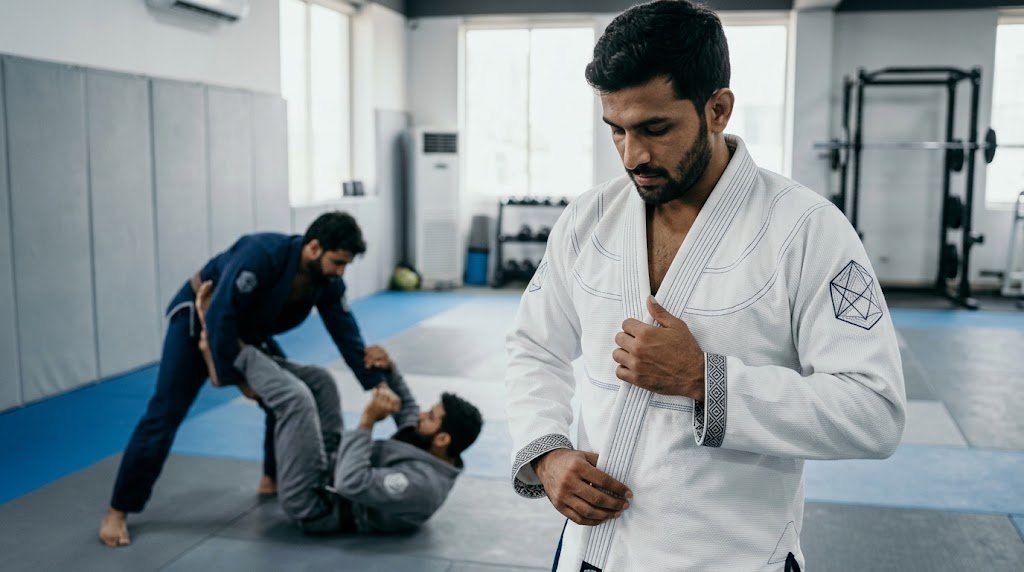
A gi, also called a kimono or simply a "kimono" in Brazilian jiu-jitsu circles, is the traditional uniform worn in gi-based BJJ training and competition. It consists of a heavy cotton jacket, matching pants and a coloured belt that indicates rank. The gi is designed to be gripped, pulled and twisted, which is why the fabric is dense and the stitching is reinforced.
A custom gi goes a step further. Instead of buying a generic uniform and adding a patch, the product is manufactured around your requirements. That can mean a specific weave, a particular jacket length, a tailored women's cut, custom-embroidered academy crests, or a private-label programme where the entire product carries your brand and nothing else.
Who typically orders custom BJJ gis?
- Fightwear and jiu-jitsu brands building a product line for retail or direct-to-consumer sales.
- BJJ academies that want matching uniforms for students, instructors and competition teams.
- MMA gyms that run gi classes alongside their striking and no-gi programmes.
- Competition teams and sponsors that need a consistent look at tournaments.
- Schools, universities and clubs running martial arts programmes or societies.
- Retailers and distributors looking for a private-label gi they can sell under their own name.
The requirements differ from buyer to buyer, but the underlying question is always the same: how do you get a uniform that fits your people, survives training, and represents your name properly?
The Main Components of a BJJ Gi
Jacket
Woven cotton in pearl, single or gold weave. The heaviest part of the gi and the piece that takes the most grip pressure.
Pants
Cotton ripstop or twill, usually with reinforced knee panels and a drawstring or elastic waist.
Belt
Colour indicates rank. Often customised with stripes, embroidery or a branded label for academies.
Patches & Embroidery
Woven patches, direct embroidery or printed panels applied to the jacket, pants and sleeves.
Labels & Tags
Neck label, size tag and care label. These carry your brand identity on the finished product.
Packaging
Gi bags, poly bags or branded boxes. Often overlooked, but part of the customer's first impression.
Fabric and Weave: The Decisions That Shape the Product
The weave is the single biggest factor in how a gi feels, how much it weighs and how long it lasts. Weave refers to the way the cotton threads are interlaced, and it directly affects density, breathability and durability.
Single weave
The lightest and most breathable option. It is a good choice for hot climates, beginners and training gis where comfort matters more than longevity. Single weave gis tend to be less expensive to produce and feel cooler on the mat.
Pearl weave
The most common weave for modern BJJ gis. The threads are woven in a small, tight pattern that looks like a grid of tiny pearls. It balances durability, weight and breathability, and it holds embroidery and patches well. Pearl weave is a sensible default for most brands and academies.
Gold weave
A denser, heavier weave that sits between pearl and double weave. It is durable and has a slightly different surface texture. Some brands use gold weave for premium or competition lines.
Double weave
The heaviest option. Double weave gis are extremely durable and difficult to grip, which is why some competitors prefer them. The trade-off is weight and heat — they are not comfortable in warm training environments and they are heavier to ship.
Pants fabric
Ripstop cotton is the most common pant fabric because it is lightweight, quick-drying and resistant to tearing. Cotton twill is heavier and softer but takes longer to dry. Some manufacturers offer canvas pants for maximum durability. Whichever you choose, the knees and the cuff hems should be reinforced — those are the areas that fail first.
Shrinkage
Cotton shrinks. This is one of the most common sources of complaints about custom gis, and it is avoidable. Ask your manufacturer whether the fabric is pre-shrunk, and request shrinkage test data from the sample stage. If a jacket shrinks two sizes after the first hot wash, your customers will blame your brand — not the factory.

Fit and Sizing: Where Most Custom Gi Orders Go Wrong
Gi sizing is not the same as regular clothing sizing. The standard system runs from A0 for smaller adults up through A1, A2, A3, A4, A5 and beyond, with additional length and width variants such as A2L for taller athletes or A3W for broader builds. Children's sizes are usually labelled M0 to M4 or similar.
The problem is that these labels are not perfectly standardised between manufacturers. An A2 from one factory can be noticeably different from an A2 made elsewhere. If you are ordering in bulk, size consistency across production runs matters more than the label on the tag.
Before production begins, confirm three things with your manufacturer:
- Who owns the size chart. Are you supplying measurements, or are they using their own block? Either can work, but you need to know which one is being used.
- How grading works. Grading is the process of scaling a pattern up and down across sizes. Poor grading is why some gis fit well in A1 and badly in A4.
- Whether women's cuts are available. A unisex gi relabelled as a women's product rarely fits well. A proper women's cut adjusts the shoulder width, jacket length and hip proportions.
Competition rules are another factor. Some federations require specific jacket lengths, sleeve widths and patch placements. If you are producing a competition gi, make sure the manufacturer understands those requirements before sampling.
Customisation Options: Patches, Embroidery and Printed Panels
Customisation is where a gi stops being a uniform and starts being a brand asset. There are several methods, and the right one depends on your design and where it sits on the garment.
Direct embroidery
Embroidery stitches thread directly into the fabric to create a raised, textured design. It is the most durable option for logos and academy crests because there is no adhesive to lift and no print to crack. Embroidery works well on the jacket chest, sleeves, back and the pants. It is usually the preferred choice for names, ranks and crests.
Woven patches
Woven patches are separate pieces of fabric with the design woven into them, then stitched onto the gi. They allow finer detail and more colours than embroidery in some cases, and they are easy to apply at scale. Because they are stitched rather than glued, they hold up well — but the stitching quality determines how long they stay flat.
Sublimation and printed panels
Sublimation printing works by bonding ink into polyester fabric, so it is mainly used on rash guards and other synthetic apparel rather than cotton gis. On a gi, you will sometimes see printed polyester panels or lining material used for contrast details. If your brand also produces rash guards, no-gi apparel or training tops, sublimation printing is a useful method to keep in the same production conversation.
Screen printing
Screen printing applies ink to the surface of the fabric. It is more common on lighter apparel than on heavy gi cotton, but it can be used for simple, single-colour marks on certain panels. For heavier garments and logos that need to survive friction, embroidery and woven patches are generally the safer choices.
Labels and finishing touches
Do not overlook the small details. A woven neck label, a size tag, a care label and branded packaging all contribute to how the finished product is perceived. If you are building a brand, these elements should be specified at the same time as the design, not added later.
Comparison: Which Gi Build Suits Which Buyer
The table below is a general starting point. Your manufacturer can help you adjust these specifications once you know your target market and climate.
| Factor | Training Gi | Competition Gi | Best Suited For |
|---|---|---|---|
| Jacket weave | Single or pearl weave | Pearl or gold weave | Training: comfort and breathability. Competition: durability and grip resistance. |
| Jacket weight | 350–450 GSM | 450–550 GSM | Lighter builds for warm climates and frequent washing. Heavier builds for longevity. |
| Pants fabric | Ripstop cotton | Ripstop or twill with reinforced knees | Ripstop dries faster. Twill feels softer but takes longer to dry. |
| Branding method | Woven patches, embroidery | Embroidery with reinforced placement | Embroidery for crests and names. Patches for larger, detailed artwork. |
| Size range | A0–A5 plus kids' sizes | A0–A4 with long and wide variants | Wider range for academies. Tighter range for competition teams. |
Common Mistakes When Ordering Custom BJJ Gis
- Choosing a weave based on price alone. A cheaper cotton may feel fine in a sample but break down faster under repeated gripping and washing.
- Skipping the pre-production sample. A digital mockup tells you nothing about how the jacket hangs, how the embroidery sits or whether the patch placement looks balanced. Always approve a physical sample first.
- Ignoring shrinkage. If shrinkage is not tested before bulk production, your size chart will be wrong from day one.
- Assuming one size chart fits every market. Men, women and children need different patterns. Relabelling a unisex gi does not make it a women's gi.
- Forgetting the details. Neck labels, care tags, gi bags and packaging are part of the product. If they are not specified upfront, they get overlooked or added at extra cost.
- Not checking patch placement on different sizes. A chest patch that looks right on an A1 can sit awkwardly on an A4. Check placement across the full size range.
Practical Examples: How Different Buyers Use Custom Gis
A Small Private-Label Brand Launching Its First Gi Line
Two training partners decide to start a jiu-jitsu apparel brand. They have a name, a logo and a rough idea of the look they want, but no manufacturing experience. They need a supplier who can advise on weave selection, recommend a weight that suits their local climate, and produce a modest first run to test demand. Their priorities are low minimum order quantities, embroidery quality and consistent sizing across the small range they plan to sell.
A BJJ Academy Ordering Team Gis for Competition Season
An academy wants matching gis for its competition team. The athletes range from lighter featherweights to heavier divisions, so the size range needs to be broad and consistent. The academy crest is embroidered on the chest and back, with the student's name on the sleeve. They order one sample gi first, confirm the fit on two or three team members, then place the bulk order ahead of the competition calendar.
A University Club Adding Branded Gis to Its Programme
A university martial arts club wants gis for its members. They are not building a commercial brand — they need a durable, affordable uniform with the club's colours and logo that can be reordered each academic year. They choose a straightforward pearl weave training gi with embroidered club branding and a simple size range, and they keep the specification on file so future orders match.
What to Look for in a BJJ Gi Manufacturer
Design support and tech packs
A tech pack is a document that describes your product in production terms: measurements, fabric, weave, stitching, branding placement and packaging. If you already have one, a good manufacturer should be able to work from it directly. If you do not, ask whether they can help you develop one. This is often the difference between a smooth production run and a series of costly revisions.
Fabric and weave selection
Ask what weaves and weights are available and how they perform in real training conditions. A manufacturer who can only offer one option may not be able to serve your specific market. You want a partner who can explain the trade-offs between a 400 GSM pearl weave and a 550 GSM gold weave, and advise on what suits your customers.
Stitching and construction
Look for reinforced stitching at the shoulders, armpits, sleeve cuffs, side seams, knee panels and waist. Ask whether the seams are double-stitched where it matters. These details are invisible in a product photo, but they determine whether the gi survives a year of hard training.
Embroidery and patch application
Embroidery requires its own equipment and skill. Ask to see examples of previous embroidery work, particularly on heavy cotton. Poor embroidery puckers the fabric, sits unevenly or pulls after washing. If your branding includes patches, confirm how they are attached — stitched patches hold up far better than heat-applied ones on gi fabric.
Sizing and grading
Confirm whether the manufacturer works from your size chart or their own block, and ask how they grade between sizes. Request a measurement chart for every size in the range before production. For academies and teams, this step prevents the most common complaint of all: an order where half the gis fit and half do not.
Sampling and quality control
Always request a pre-production sample. The sample lets you check fabric hand-feel, weight, fit, shrinkage, embroidery quality and stitching. A manufacturer who is reluctant to provide a sample, or who charges disproportionately for one, may not be the right long-term partner.
Production quantities and private label
Minimum order quantities vary widely between manufacturers and are often calculated per design, per colourway or per size range. Clarify this before you plan a product line. If you are building a brand, also confirm what private-label options are included — woven neck labels, size tags, care labels and packaging are usually separate line items.
Where Habit Fit Sports Fits Into Your Gi Production
Habit Fit Sports works with brands, teams, gyms and businesses looking for custom sportswear solutions. The company manufactures custom and private-label apparel, including wholesale BJJ gis for brands, gyms and teams. The process covers design support, fabric and weave selection, embroidery and patch application, sizing, sampling and private-label branding.
For brands that also produce no-gi apparel, Habit Fit Sports offers custom rash guard manufacturing and has published a detailed guide on choosing the right custom rash guard for BJJ and MMA. This means a gym or brand can source gi uniforms and no-gi training gear from one supplier instead of managing separate manufacturing relationships.
On the decoration side, the company provides embroidery services for logos, crests and names, along with screen printing and sublimation printing for other garment types in the same range.
If you are planning a gi order, you can review how the production process works or contact the Habit Fit Sports team to discuss your design files, size requirements and branding needs. You can also see the full range of sportswear manufacturing services on the Habit Fit Sports homepage.
Frequently Asked Questions About Custom BJJ Gis
What is the best weave for a custom BJJ gi?
For most brands and academies, pearl weave is the most practical choice. It balances durability, weight and breathability, and it holds embroidery and patches well. Single weave is lighter and better for hot climates or beginner gis, while gold and double weave are heavier and more durable but warmer and more expensive to produce.
How much does a custom BJJ gi shrink?
Cotton gis can shrink, especially if they are washed in hot water or tumble dried. The amount depends on whether the fabric is pre-shrunk and how it is finished. Ask your manufacturer for shrinkage test results from the sample stage, and include washing instructions on your care label so customers know how to look after the gi.
Can I put my academy or brand logo on a gi?
Yes. Embroidery is the most durable method for crests, names and logos on heavy cotton. Woven patches are a good option for larger or more detailed artwork. Both are stitched onto the garment, which is why they hold up better than heat-applied transfers on gi fabric.
What sizes should I order for a gym or academy?
It depends on your membership. Most academies stock A0 through A4 or A5, plus kids' sizes, with long and wide variants for athletes who fall between standard sizes. Ask your manufacturer for a full measurement chart and consider ordering a sample in two or three sizes before committing to a bulk run.
Do I need a tech pack to order custom gis?
A tech pack makes the process smoother because it documents measurements, fabrics, stitching and branding placement in one place. It is not always mandatory — some manufacturers can work from reference samples and design files, and some can help you build a tech pack from scratch.
What is the difference between private label and OEM gi manufacturing?
In private-label production, the manufacturer uses an existing gi pattern and you apply your branding, labels and packaging to it. It is usually faster and simpler. In OEM production, the gi is built to your specifications, which can include a custom pattern, specific weave and construction details. OEM gives more control but requires more input from you.
How should I store my gi specification for future reorders?
Keep a written record of the weave, GSM, size chart, embroidery file, patch dimensions, label details and packaging. If you reorder a year later, this record lets the manufacturer reproduce the same product instead of starting again — and it protects you from the small variations that creep in when specifications are passed on verbally.
What to Remember About Custom BJJ Gis
A custom BJJ gi is a functional product before it is a branded one. The weave and weight determine how it feels and how long it lasts. The sizing and grading determine whether it fits your members. The stitching and reinforcement determine whether it survives real training. Only after those foundations are right does branding come into play.
Start with the technical decisions, approve a physical sample, and confirm the size chart before you order in volume. Keep a record of every specification so future runs match the first one. That is what separates a product line from a one-off order.
Habit Fit Sports manufactures custom BJJ gis alongside other sportswear products, giving brands, gyms and teams a single source for their apparel needs. If you are developing a gi for your academy or brand, exploring the manufacturing options is a practical next step.
Ready to Develop Your Custom BJJ Gi?
Whether you are launching a private-label gi line or outfitting your academy for competition season, Habit Fit Sports can help you move from concept to finished product.
Explore Wholesale BJJ Gi Manufacturing Contact UsHave a specific specification in mind? Get in touch to discuss your designs, sizes and production requirements.